The Voice of Fashion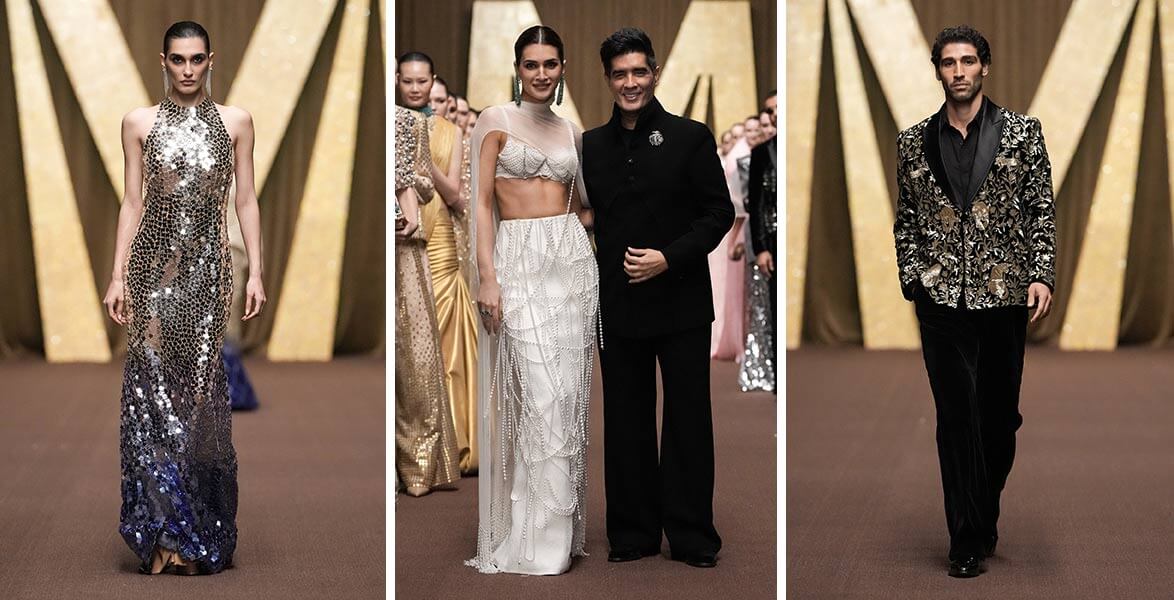
Watching Malhotra’s finale at Dubai Fashion Week made evident why his high-voltage couture—built on the three prisms of scale, surface and spectacle—finds traction in a market where luxury must first be seen before it is experienced
Manish Malhotra is no longer merely a participating guest designer at Dubai Fashion Week (DFW). His return this year as the finale designer, with Inaya: The India Story, signals a creative continuity that is taking shape. It is not a series of one-off appearances by one of India’s most recognisable couturiers to import Bollywood glamour and spike interest in the event.
Even before the show began at the Dubai Design District (d3), the buzz—quite literally, the brilliance, given Dubai’s appetite for crystals and shine—among guests in the lounge areas made it clear this was a finale people had been waiting for. It would be simplistic to attribute the anticipation to the prospect of spotting a Bollywood star on Malhotra’s runway; that is a given. What was less predictable, at least for this writer, was seeing Malhotra’s couture already worn by several guests filing in to take their seats. Long sequinned gowns, thread-worked jalabiyas, embroidered overlays and ensembles that spoke fluently in two languages—made in India and meant for the Middle East. They did not need translation or persuasion.
Calibrated for the UAE Market
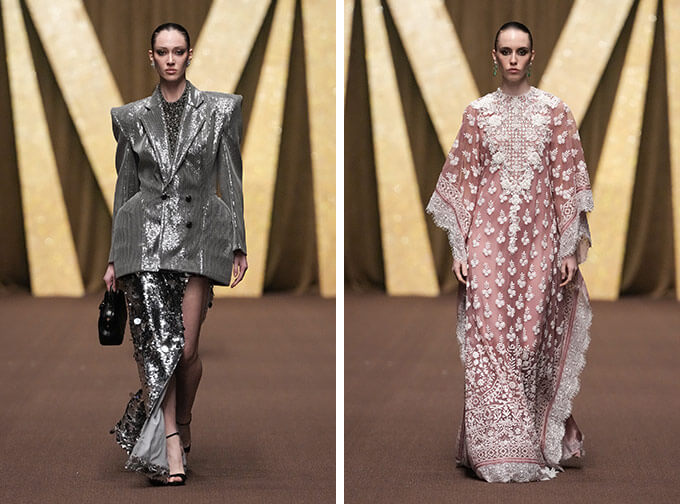
When the show finally beamed onto the runway—well beyond its calendar hour—it cruised to a heady music playlist (available on Spotify), as Inaya unfolded its Dubai–India sartorial dialogue. Pearls and dense embroideries on rich fabrics; decorative ombré dresses in gold and midnight blue; dazzling grey-black and charcoal gowns; fluid jackets and body-contouring silhouettes with and without slits; pastel-hued jalabiyas that reinterpreted the grammar of chikankari. It was evident that Malhotra had designed with this market squarely in mind. Being regionally attuned, rather than “vaguely international” without strategy, is a smart move.
Some garments appeared overly embellished, almost aggressively bling. But they aligned precisely with the dressing instincts of the audience. Lucknawi chikankari, zardozi, Kashmiri threadwork and other artisanal embroideries were lit up with sequins, pearls and crystals—ornamentation as excess and expectation.
Malhotra says as much. “As a designer, it is a very important aspect of my work to take the craft of Indian artisans to global platforms, including the Middle East, and adapt it to their culture.” He points to the jalabiyas designed with the upcoming festive month of Ramadan in mind, adding that all embroidery is executed in India. The pearl work worn by his showstopper, actor Kriti Sanon, was crafted in his Delhi ateliers. “The clothes hold an amalgamation of Indian craft with Chantilly lace and other finer details. Yes, of course, the Middle East remains in my thought process, and the designs may be modest compared to what we may make in India,” he adds.
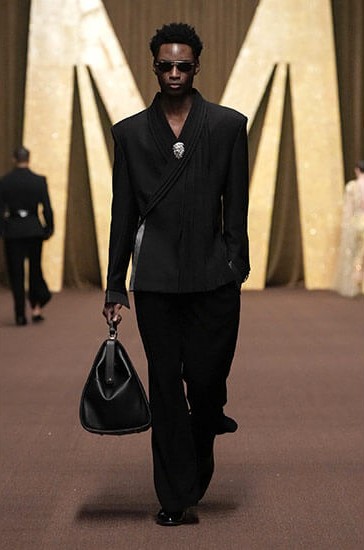
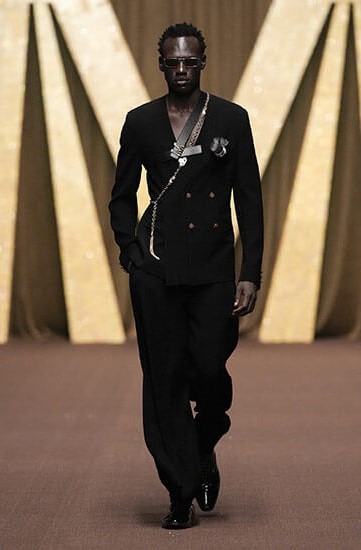
It was, however, the menswear in this collection that emerged as the highlight—refined, restrained and sharply tailored, in luxe fabrics rendered in black and deep emeralds. The sherwanis resisted ceremonial inevitability; instead, they were culturally agile. Capable of dressing a party in Hollywood as convincingly as one in Paris. Give it wings, Mr. Malhotra. Let the menswear acquire multiple passports and travel.
Dubai’s Fashion Ecosystem
The broader DFW platform, established with the city’s design district, has steadily featured a growing roster of international designers. It positions itself as a runway of choice and diversity—distinct from traditional fashion capitals, according to founder Jacob Abrian. Through its founding body, the Arab Fashion Council, DFW supports the region’s ambition to build a cosmopolitan, multi-cultural fashion ecosystem. Its decisions and investments actively accelerate this vision. Last year, the Council launched a $500,000 Fashion Fund to support emerging designers and help them scale into global brands—an infrastructure-led approach to investing in fashion’s future.
The market supports this optimism. In the UAE, according to market research organisation Deep Market Insights, the luxury apparel market was valued at approximately $3.67 billion in 2024, with forecasts projecting growth to around $5.45 billion by 2033—signalling a sustained appetite for designer fashion and high-end retail. The wider UAE luxury goods market (including fashion, accessories and lifestyle) is pegged at close to $8.98 billion in 2026, with continued growth projected through the decade, according to Mordor Intelligence. Fashion events—including DFW and allied platforms—form a significant and expanding segment, with the UAE fashion events market estimated at $1.5 billion in 2023 and projected to reach approximately $3.8 billion by 2034, according to Allied Market Research.
The menswear in this collection emerged as the highlight—refined, restrained and sharply tailored, in luxe fabrics rendered in black and deep emeralds.
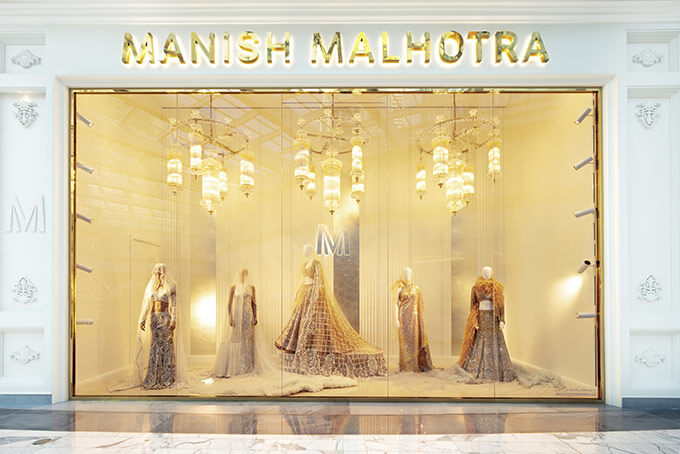
Seen against this backdrop, Malhotra’s 5,000-square-foot flagship store at The Dubai Mall, launched in December 2023, signals its intentions clearly. Housing couture alongside high and fine jewellery, bags and belts—with accessories introduced more recently—the store places the designer at the heart of the Gulf’s most competitive luxury retail landscape. That its founder has now presented two finales at Dubai Fashion Week reinforces the seriousness of this positioning.
Malhotra’s first foray into the region dates back nearly three decades; some may call this a natural evolution. But viewed strategically, it reads instead as a long arc of familiarity meeting a market ready to reward scale and ambition. Further expansion of the multiple Manish Malhotra brands across Middle Eastern cities may only extend that logic.