The Voice of Fashion
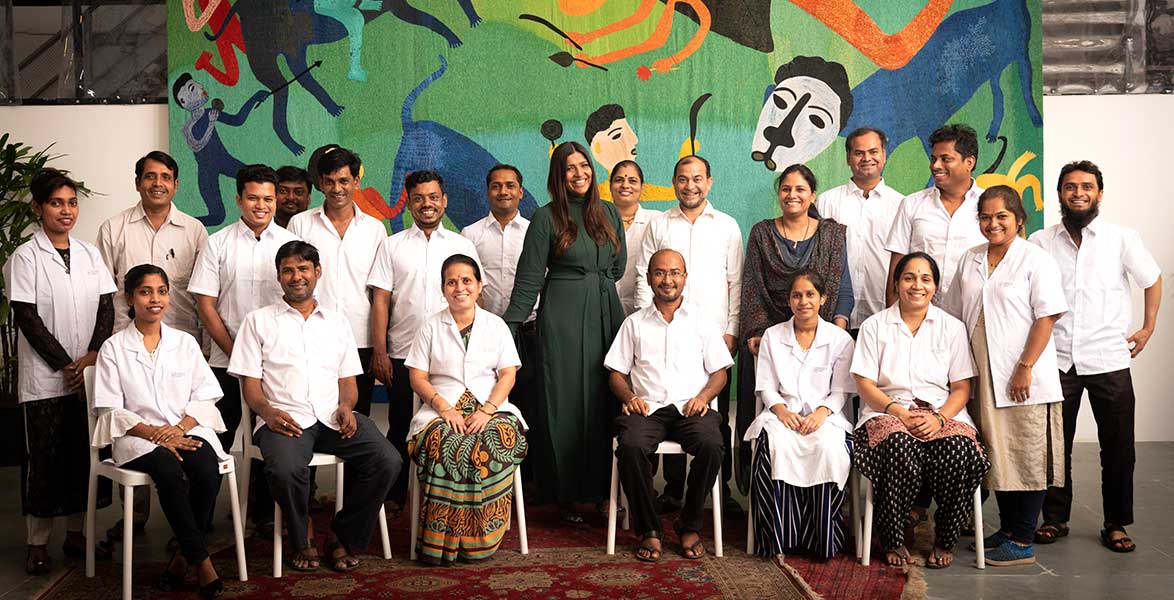
What stood out at Chanakya’s 40th anniversary, besides the extraordinary work on display, were the people who came to stand as a community.
Two days ago, while in Mumbai for the exhibitions and events marking 40 years of Chanakya International—the house of textiles and embroideries which, for the last 15 years, has also run a School of Craft and a Foundation—I noticed something particularly restorative.
Across three exhibitions at three distinct venues (a separate feature on the exhibitions will be on TVOF in the coming week), I observed the kind of visitors who came to applaud Karishma Swali, the creative director, her brother Nehal Shah and their extended family of craftspeople and students. What I “felt” was the embrace of a community. Curators, craft enablers, artisans, educators, and scholars from interdisciplinary fields had turned up in congratulatory solidarity.

“Felt” is an intentional word here. When I mentioned this to Lavina Baldota of the Baldota Foundation, who leads the travelling exhibition Santati: Then, Now, Next, she said, “Well, we do show up for each other.”
At that precise moment, Baldota was with Radhikaraje Gaekwad of Baroda, who runs the Maharani Chimnabai Stree Udyogalaya. As I did a 360-degree turn, especially at the Dr. Bhau Daji Lad Museum, where En Route, one of Chanakya’s three exhibitions, is on display, stalwarts were everywhere. Artists Manu and Madhvi Parekh have been collaborators with Swali and Maria Grazia Chiuri when she was at Dior; there was Darshan Shah of Weaver’s Studio, Kolkata; Monisha Ahmed, scholar and founder of the Ladakh Arts and Media Organisation; and many others. Curatorial advisor to En Route, Tasneem Zakaria Mehta, spoke about international communities tied to Chanakya’s work.
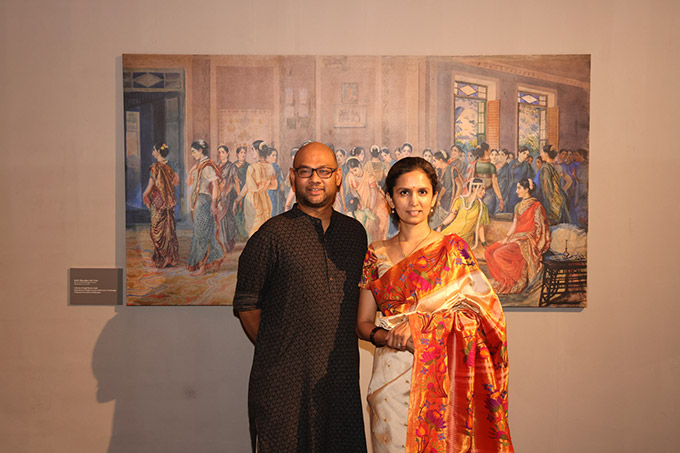
The next morning, Priyanka and Prateek Raja, founders of the Kolkata-based Experimenter gallery, opened a conversation around Belong—Chanakya’s third exhibition, on view at their space in Colaba. They explained why they had chosen to work with Swali and Chanakya, and the rightful importance of crediting every craftsperson in the artworks emerging from the institute.

In fashion, and often in art, one rarely sees direct competitors attending each other’s shows. They may turn up at each other’s parties. Fashion’s communities are not necessarily as porous; rivalries over attention, visibility and sponsorship can work differently in that industry. Art, meanwhile, is as much about the cult of personality and the high value of individual authorship. “Community” is not such a prized word or vibe in art fraternities either.
But craft, which has always been essentially transmissive and about communities—even when its products are made for a luxury brand or the richest buyers in the world—is making its social networks increasingly consequential. That is what I wish to point out. The community presence reflects the spirit of turning up for someone else’s work and success. It is also an applause for the inclusion of craftspeople from different slices of the economic ladder and geographies.
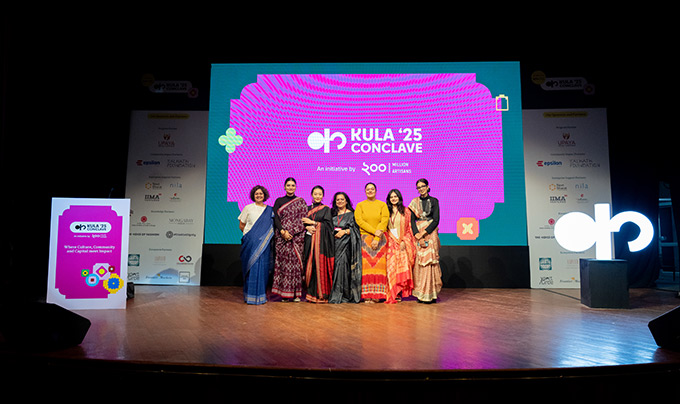
My most recent observation is about Chanakya, but this is not an isolated anecdote. I have seen a similar sentiment course through Kula Conclave in Jaipur; at awards ceremonies for digitally empowered artisans held by the Digital Empowerment Foundation; at symposiums by Creative Dignity; at events mounted by LLDC Shrujan in Kutch; at the exhibition Textiles of Bengal: A Shared Legacy by Weaver’s Studio in Kolkata; and at exhibitions and talks organised by the Bengaluru-based Registry of Sarees.
It is a pattern.
The skill and prowess of Indian craftspersons is finally, and rightfully, being acknowledged in the current crafts renaissance. They are now being viewed as authoritative makers and creators—which is why the “community” is global-local and rural-urban. Institutions such as Delhi’s Devi Art Foundation, Pune’s TVAM Foundation and Maheshwar’s WomenWeave, which runs The Handloom School, are part of a larger shift. The artisan is no longer simply the invisible hand behind an object, but increasingly a named author of knowledge.
This is not to say that there will be no rivalries, exclusions, hierarchies or inequalities. But the way craft is acquiring a collective confidence, creating a community of its own, is beginning to alter its place in India’s cultural imagination.
Yet, as Indian craft finds increasing resonance and influence across the world, the word “community” comes with both caution and opportunity. Romanticising the fact that the more privileged and city-based among the crafts world are showing up for one another would skew the argument. Anthropologist Soumhya Venkatesan’s work on the mat-weaving community of Pattamadai in Tamil Nadu, for instance, has shown how the term “craft community” can conceal individual agency and internal tensions.
Clearly, though, there is something palpitating in the visible rise of communities around craft in India. It has directional value. Social infrastructure will bring in leverage. The lesson maybe for Indian fashion is not that craft is catching up with it, but that it is building something fashion struggles to sustain: a community capable of turning individual achievement into collective leverage.
Banner: Karishma Swali and Anisha Shetty with master artisans of Chanakya International and graduates of the Chanakya School at the Chanakya Atelier. Photo by: Hashim Badani