The Voice of Fashion
The question was never whether John Galliano was a brilliant designer. It was whether brilliance, however extraordinary, is enough to justify institutional honour
“Meaningful atonement is not achieved through an exhibition, institutional recognition or a single public gesture. It is a continuing responsibility, demonstrated through listening, learning and one’s conduct over time.”
Those are designer John Galliano’s words sent out yesterday as he withdrew from the exhibition at New York’s The Costume Institute, planned for 2027 by The Metropolitan Museum of Art (Met). Galliano said he remained “fully accountable for the pain caused by his past words”, particularly to Jewish and Asian communities. He added that he understood why an exhibition honouring his work could be painful for some.
It was a clear-eyed statement. Very indicative about the changing position of fashion itself.
For a long time, fashion was protected by its “unseriousness”—some of it self-claimed. Words like “frivolous” and “ephemeral” kept being heaped on it for its preoccupation with body, beauty and the privilege of those who could buy or command it.
View this post on Instagram
Designers were allowed to be difficult. Especially men. They didn’t lose their jobs at high-profile Western brands for being eccentric or even outrageous in their behaviour. After all, it was “only fashion”. In India, where a majority of big fashion and luxury brands are directed and run by founding designers, there has seldom been a clear or unclear work “ethic” for bosses. Especially for men.
Creative genius? Powerful? Of course, that person could be dismissive of the dignity or pain of others and get away with whatever. Work was to be admired, especially if profitable and brilliant; the person could be conveniently separated from the harm they brought.
That protection is disappearing.
Today, fashion has become too culturally powerful. It is now too visible across genres to claim the privileges of frivolity when it suits it and the prestige of art when it wants recognition. Fashion museums, schools, foundations and, above all, the influential cultural machinery around the Met Gala itself have underlined fashion as “serious” over the years.
That’s where the objection against the very choice of Galliano stands.
The Galliano Test Was Complicated Anyway
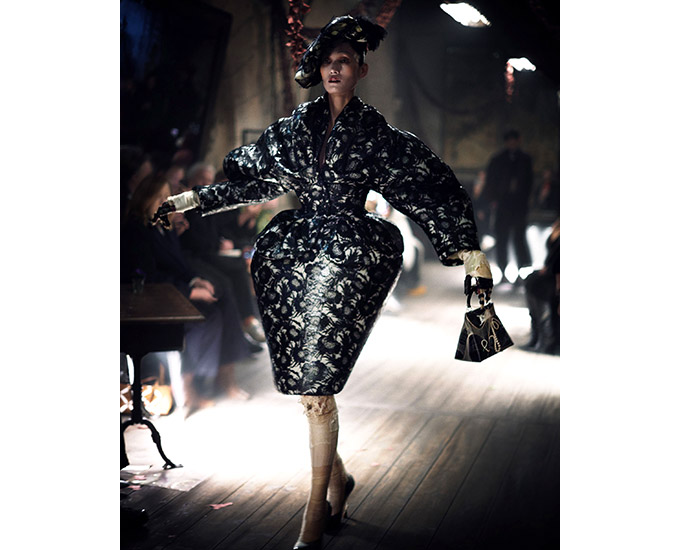
John Galliano: Horizons was never marketed as an uncomplicated celebration of a designer’s genius. The Costume Institute had planned on mounting four decades of his work, from his beginnings at Central Saint Martins in London through his own label, then Givenchy, Dior and Maison Margiela.
Andrew Bolton, the institute’s chief curator, had made it amply clear that the exhibition would confront Galliano’s fall from grace—the antisemitic and anti-Asian remarks that led to his dismissal from Dior in 2011, and his conviction by a French court for public insults based on race, religion and ethnicity. That he went to take treatment for addiction, and the long process of rehabilitation and return were not being erased. They were a part of the intended story.
But a catch lay here. An exhibition of Galliano is one thing, and honouring him is another. Only two greats—Yves St Laurent and Rei Kawakubo—have had similar honours with solo exhibitions. The Met was proposing an equally major retrospective devoted to Galliano’s brilliance.
Nothing is Politically Neutral
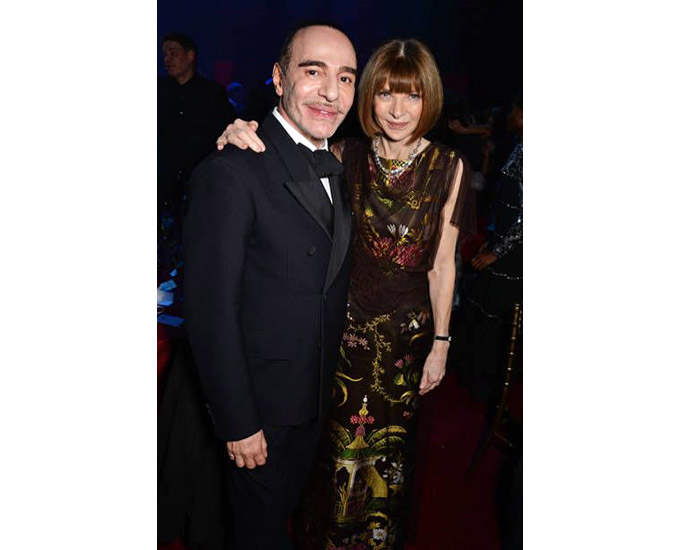
Such decisions are seldom made or received from a politically neutral place. Not in today’s world. Bolton, the Met’s CEO Max Hollein, and Anna Wintour, the lady behind galvanising The Costume Institute’s exhibits and gala, are not amateurs. They know fashion history, Galliano’s work, and the controversies surrounding him. Wintour and others at the Met had reportedly even consulted Jewish leaders and rabbis about the decision, and some said they believed Galliano’s remorse was genuine. After all, the Anti-Defamation League had itself accepted his apology years earlier.
But the objections and the subsequent withdrawal reveal that fashion cannot be detached either from politics or personal conduct. The rise of the Right across the West, the return of explicitly nationalist politics, the return of antisemitism in pockets, new battles over race, migration and gender have altered the landscape everywhere.
The Met’s dilemma, as it has now appeared, was not between art and morality. It was between two legitimate responsibilities: the responsibility to examine difficult histories, and the added responsibility to understand what an institution communicates when it honours people. Even when they are as extraordinary as Galliano.
It began with Dana Thomas, Galliano’s biographer, among the earliest critics of the choice. Jewish leaders, New York politicians and some Met donors joined her voice. Alice Tisch, a prominent Met donor, reportedly called the proposed exhibition a “whitewash”. New York City Council Speaker Julie Menin, whose mother is a Holocaust survivor, called the decision deeply painful. Jonathan Greenblatt of the Anti-Defamation League, despite acknowledging that his organisation had long accepted Galliano’s apology, ultimately described the Met’s decision as “the wrong move at the wrong moment”. His words could serve as an alternative headline for this article.
Filling The Vacancy
Who will replace Galliano now? That’s an equally inciting question. A Black or Latino or Asian designer? Male or female? Or, white European? All propositions sound equally tricky. Choosing from outside the Western canon will indicate over-correction and a balancing exercise.
The Met cannot win by reducing the politics of representation to an arithmetic between gender, sexuality, ethnicity or migration status. Nor should it.
How Should India Read This?
India is enthusiastically building its fashion infrastructure. Or so it seems in the way it is linking heritage with new design and new wealth. Museums, archives, exhibitions, biennales, design schools, private collections and institutional histories are stacking up. We are beginning to decide who belongs to the national story of fashion. Perhaps we don’t know yet who does not belong.
There is a particular danger in India because our systems of cultural recognition are still heavily dependent on patronage and film celebrity. Proximity to political power is seen as a pass for creative brilliance. We remain remarkably forgiving of the powerful.
While in all likelihood, India will watch with an oblique eye and move on, maybe the Galliano episode could teach us how to argue with our heroes.
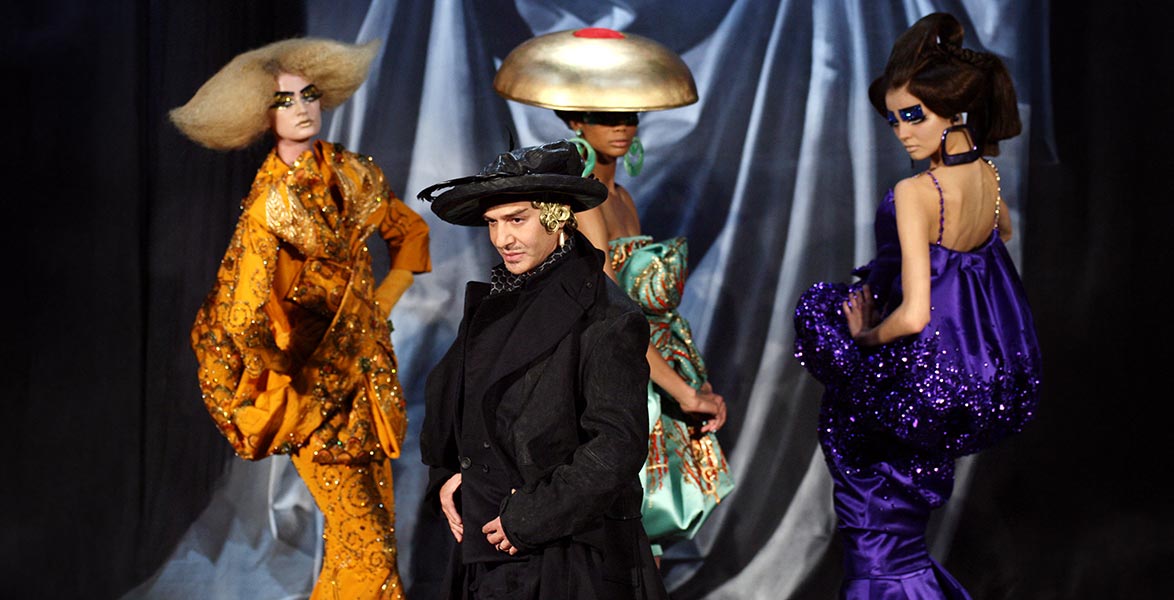
Banner: John Galliano with models wearing his designs for Dior’s Spring/Summer 2008 Haute Couture collection in Paris.
Photo by Francois Guillot / AFP