The Voice of Fashion
The Delhi High Court’s injunction in Rahul Mishra’s case is a reminder that Indian fashion should not treat plagiarism as an occupational hazard
Plagiarism being as old as design, its recurring instances as one of fashion’s biggest crimes, is a returning leitmotif. In India, designer copies have created a parallel, prolific and prosperous industry for years. Designers from Sabyasachi Mukherjee to Masaba Gupta, Anita Dongre to Tarun Tahiliani and Ritu Kumar have lamented it in interviews. Social media has shamed the more egregious copycats, and consumers have laughed off knock-offs as inevitable. Some like Mukherjee, Kumar and Tahiliani have taken their trademark and copyright battles to court and won. Rajesh Pratap Singh and Mukherjee have used the copyright law to trademark patterns, silhouettes and prints or original design elements, that distinguish their work.
Now with Delhi High Court’s order delivered on August 4, in favour of Rahul Mishra, the industry can no longer afford to treat plagiarism as an occupational hazard. Copycats don’t just steal embroidery or motifs or colour palettes; they hollow out the cultural and economic blocks of Indian couture.
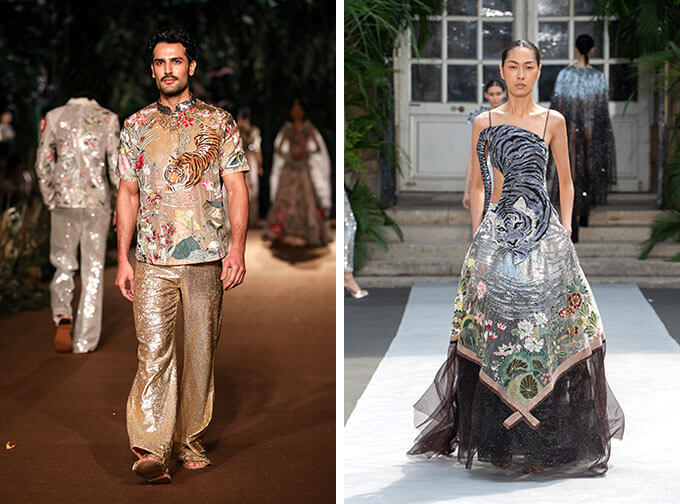
It is theft, and it should be taken to court every single time. Mishra and his team spent months documenting what was going on, sued and won. The case centred around his Tigress motif, which—besides other floral embroideries and renderings from the Sunderbans capsule in the We The People couture collection—was first shown at Paris Couture Week in July, 2023, and then in Delhi. The motifs were found replicated in e-commerce and market knockoffs, being promoted on Instagram. Not by one errant manufacturer or designer in disguise, but several. It led to the unearthing of a supply chain of replicas.
By the injunction—a copy of which is with The Voice of Fashion—one defendant was pinpointed as the manufacturer of the infringing fabric, who was found supplying it to multiple retailers and online sellers. As many as 16 others were also named as defendants. This wasn’t casual copying; it was a supply-chain level operation.
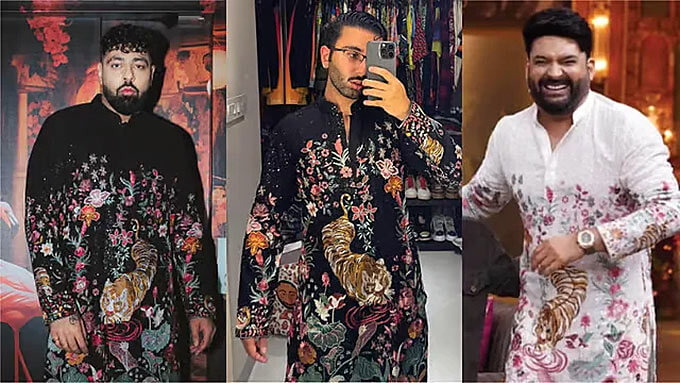
Let’s divert for a moment to a useful irony. How fame brought some unexpected gains. In this case, particularly, the fame of those who acquired, wore and were photographed in Mishra’s unauthorised counterfeits—TV personality Kapil Sharma, Punjabi singer-songwriter Badshah and social media influencer Orry. Their social media images, highly circulated, brought the problem into sharp notice.
But there are several other significant takeaways from the High Court order, which should embolden designers—young, emerging, veteran or established.
Couture is Intellectual Property
Justice Tejas Karia granted an ex-parte ad-interim injunction restraining all 18 defendants from producing, advertising, or selling copied works. Several had already admitted guilt in writing—apologising, taking down listings, or pleading ignorance. The court ordered them to formalise these undertakings, disclose sales records, and in one case, even compelled retail platform Etsy to reveal the identity of a seller.
This matters for several reasons. First, the order reaffirms that couture is not ephemeral glamour; it is intellectual property. Court orders on fashion were not on the top of copyright wars for many years, but now the HC recognises that it can damage brand value and dilute the global credibility of Indian couture. By treating embroidery motifs and garment “get-up” as protect-worthy creations, the court has given legal recognition to what many in the industry still regard as intangible. The judgment was delivered quickly. In a country where plagiarism is often normalised, this is no small shift.
Ignorance is Crime Too
Second, it dismantles the weak but often presented defence: “We didn’t know, so we are innocent”. Many retailers and small businesses caught selling Mishra’s plagiarised designs claimed they were unaware of the ownership. Some said they had just sourced fabrics from suppliers and had no idea if there was a designer being copied. The court’s injunction, however, makes it clear that ignorance is no shield against liability. If you sell what you do not own and profit from it, you are complicit.

Recognition of Fashion and Luxury
Third, the order recognises that luxury relies on scarcity, painstaking craft, and distinctiveness. Flooding the market with cheap replicas does not only confuse consumers, it adulterates the very idea of why Indian couture matters, from pricing to appearance to where and how it is made. Mishra’s global reputation—built on years of investment, fashion shows, media coverage, and collaborations—was being undercut by a parallel marketplace offering “express delivery” tiger embroidery at cut-rate prices.
It Is Not just about Couture
There is a larger message here. For Indian fashion to hold its own globally, it cannot allow copycats to dictate the market. The same industry that seeks Geographical Indication tags for Banarasi brocade or Odisha Ikat must fight to preserve the integrity of modern couture made in city ateliers by designers. Protecting artisans’ skills and the intellectual labour of designers are two sides of the same coin, especially in this country.
Flooding the market with cheap replicas does not only confuse consumers, it adulterates the very idea of why Indian couture matters.
Designers, for their part, must abandon their reluctance. Too often, plagiarism is brushed aside as “part of the game”. But every plagiarised garment sold online or in small markets chips away at a brand’s credibility and at the wider respect Indian fashion commands abroad. Rahul Mishra’s decision to go to court, rather than just lament and wrangle on Instagram, is therefore important. Undoubtedly, legal recourses cost money and litigation is expensive. It can only be built on long research and documentation, including of the copycats’ ways and works, how and where they are selling.
The order should embolden all designers—emerging, mid-level, regional—to assert ownership of their work. The law can only act when it is invoked.
This order isn’t just Rahul Mishra’s win. It’s a call to arms for Indian designers to guard their creative labour in the courtroom, not just on Instagram.