The Voice of Fashion
Jio Hotstar’s new reality series Pitch to Get Rich is tackily produced and packed with theatrics on the business of fashion. By accident, it also teaches founders and designers what not to do
It was a potentially “prosperous Diwali” for fashion founders chasing funding, investment, and mentorship through a competition styled as reality TV. Jio Hotstar’s new series Pitch to Get Rich arrived with some build-up, as the next big thing for India’s fashion entrepreneurs. Film personality Karan Johar, who appeared with actors Akshay Kumar and Malaika Arora, had dropped teasers earlier in the month.
In promos of the series, fashion looked like its own parody. Bollywood celebrities dressed by stylists, who needed a Diwali break if not a sabbatical, a medley of forced puns, synthetic banter, painted nails, visible hierarchies, and the inevitable shots of models walking runways.
Pre-launch PR emails sent to the media spoke of a new godfather of Indian fashion in this mix, ostensibly a “rank outsider” with mentions of the Fashion Entrepreneur Fund (FEF) and Johar’s Dharmatic Entertainment, the two bodies that have brought us the show.

The Pitch
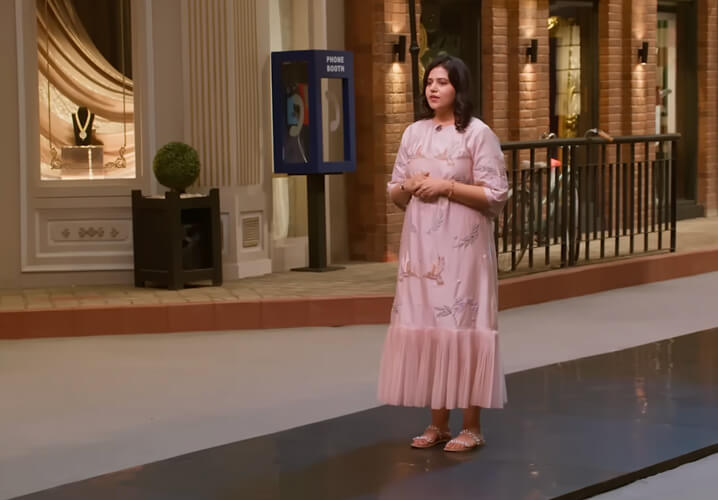
In its actual streaming avatar, Pitch to Get Rich (eight episodes, each under an hour, that invite pitches from 14 brands) turns out to be the next small thing for India’s fashion founders. The problem isn’t the ₹30-crore funding pool—it’s generous and a good start. Nor is the concept flawed: giving emerging brands, designers, and creators a platform to pitch for investment and mentorship is what the Indian fashion industry needs.
Shark “tanking” it—or turning it into a tough competition, at least on script, was meant to add muscle, not melodrama. The 14 founders are put through sharp pitches, brand storytelling, valuations, customer insights, financial discussions, and expert feedback, all wrapped in the emotional graph of reality TV. On paper, that’s fine too.
What you get though, is a hit and miss attempt of a fashion competition, that might have reminded many of sitting on some student juries and trying to point out the basics. That was the job of the screening team, who shortlisted the participants for the show.

The Jury is Out and Loud
Those who received funding—whether it was Rs 70 lakh or Rs 3 crore or more (from the pool that was eventually raised above its Rs 30 crore promise) or different percentages of equity for Fashion Entrepreneurship Fund—may have benefitted. But the show does little service to the aesthetics, the business, and image of Indian fashion. The way the set and the entire production is styled—loud and cacophonous in terms of design, more Kahaani Ghar Ghar Ki than a boardroom for business of fashion set with stakeholders and industry biggies—should worry some of us if indeed, this is how the “face” of fashion is perceived.
Star judge Johar, who also introduces each episode with sensible arguments in well-spoken Hindi, looks in urgent need of fashion lessons himself. Some will argue that he has been the gossiping world’s favourite victim for a long time now, since his successful slide down on the weighing scale. KJO’s current style may be OTT (over the top) or alligator green with shoes the size of miniature tanks and spectacles the size of little saucers, but that doesn’t mean we are obliged to applaud.
If there is anyone dressed more conspicuously than him on Pitch to Get Rich, from the point of view of occasion suitability, it is Malaika Arora. She appears in sacks of different kinds of cloth in different episodes. Difficult to define gowns and drapes that grind and bind her in unrelenting un-cool. Her plus-sized finger rings, apparently a part of the “lewk”, are distracting even when she is only announcing the name of the next contesting brand founder.
The Buzzword Bazaar where Everything is Luxury
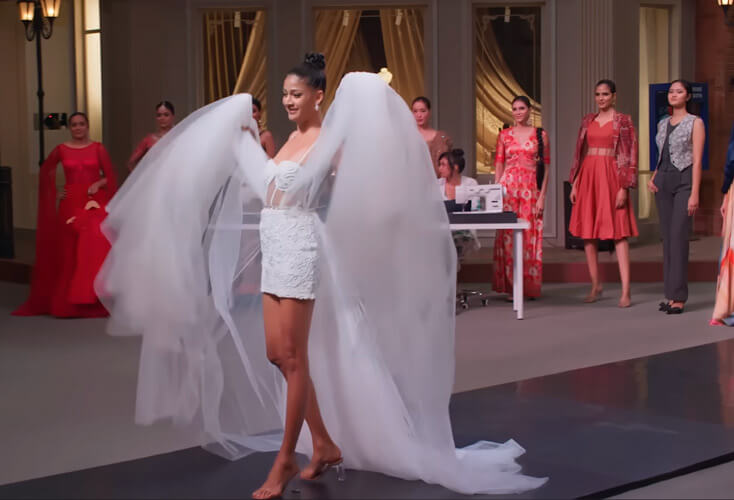
The language of the show spews a jumble of words—luxury, casual wear, cool, bespoke, tailoring, bridal, sangeet, phera, accessories, denims, ethnic Indian, artisans, embroidery, organza, silk, design-led, unique, blah… as if it is some warehouse from which any word, any category, any variant of fashion can be pulled out and turned into a magician’s hat. One of the most concerning issues that add to the mediocrity of fashion retail in our country is this very mashup—any designer can create anything and call it luxury. They label their brands “design-led”, while going after derivative patterns, colours, embroideries and silhouettes, produced through unsupervised and exploited sweat shops.
Indian wear is clichédly packaged with words like artisan-made and hand-made (sometimes only for socio-cultural branding) and all bridal wear, including the likes of which sell from Karol Bagh in Delhi to Manish Market in Mumbai, are proudly claimed as designer wear if not “luxury”, again.
The producers and directing team of Pitch to Get Rich had a fundamental duty to at least separate “fashion” from mass brands, instead of categorising everything under one massive umbrella. Previous
Fashion Plays the Second Lead
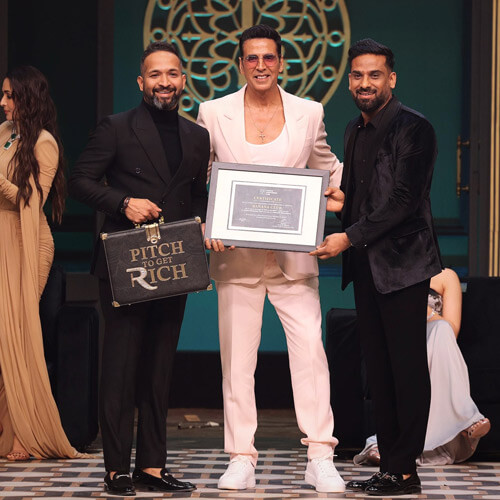
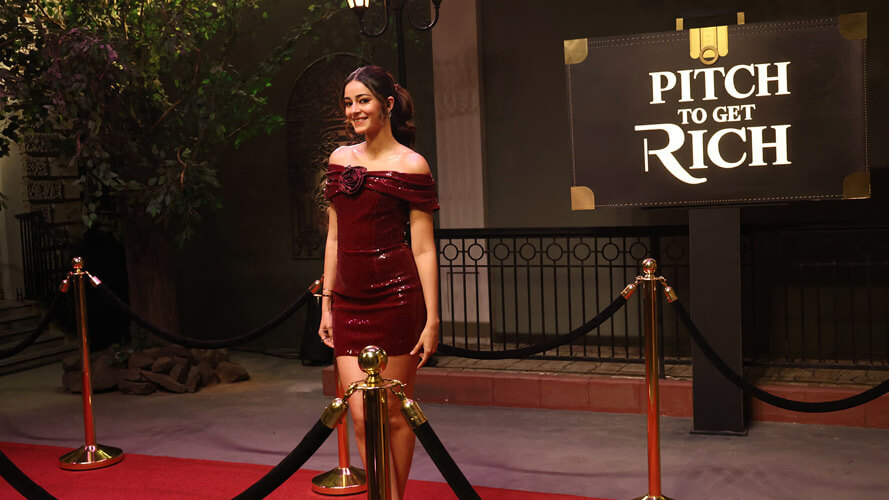
Finally, but not quite the badshah of clichés, the show’s hierarchy-ridden format ends up reflecting exactly what ails Indian fashion. It is dominated by “Bollywood”—from those in the jury to those in the audience during the finale when the results are announced. Not to forget, peripheral to fashion young actors like Sara Ali Khan invited here as a celebrity “customer” for whom the founders are tasked to make a garment. Then there is Kumar, cast like a guardian angel of strugglers, who swaggers in and out of the set, with no apparent connection.
When “industry experts” are brought in (from fashion, retail, business, education, production, marketing) who the competing founders are given interactive meetings with, you realise how their pecking order is presented as “below” Bollywood in their understanding of fashion. The presence of couturier Manish Malhotra, deserving of his place on the jury, and the competitors’ interaction with Raymond’s Gautam Singhania were relevant and smart touches. But if you are looking for ways to scale up your business by divesting equity as a designer or a brand founder, this show will teach you what not to do.
Ironically, no one speaks of design in a level-headed way. Fashion, of course, is treated like a coin tossed in the air—whichever way it lands, heads or tails, it’s apparently worth investing in. That’s a rich assumption.