The Voice of Fashion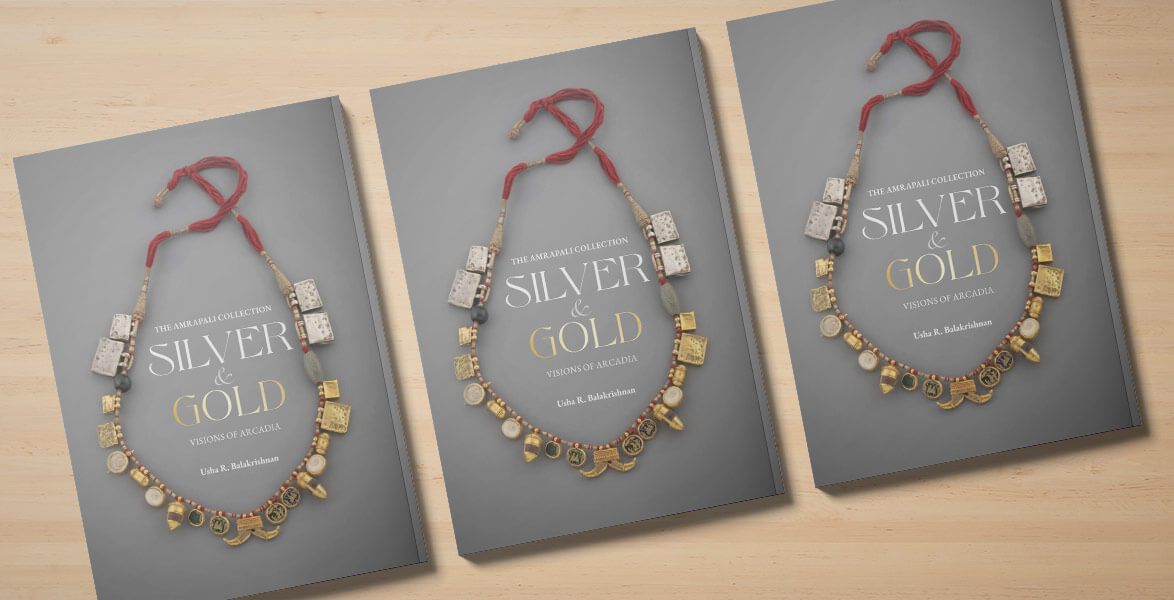
A new book by jewellery historian Usha R. Balakrishnan, reminds us why gold and silver are precious at a time of renewed urgencies to value nature
The Amrapali Jewellery Collection began to take shape more than 40 years ago at Jaipur’s Amrapali store, when two friends, Rajiv Arora and Rajesh Ajmera found themselves face to face with pastoral India through a chance encounter. As is known, a rural couple came to them, carrying their life story in silver worth. Visions of Arcadia, the now expansive pastoral silver jewellery archive held as part of the famed Amrapali Collection, is unique, and not only because it is one of the few such in the world. But also, because it is like the two-faced Greek God Janus—one facing the past taking us back to a bygone era. The other reminds us of the value of pastoral materials, ways of living, believing and making at a time when these concerns have acquired renewed urgency amidst climate change anxieties.
Silver & Gold: Visions of Arcadia by historian and author Usha R. Balakrishnan, a new collectible coffee table tome by Mapin, emerges from a uniquely Indian imagination. Its context is shaped by secularism, diversity, and cultural multiplicity. Across communities, religions, and languages, gold and silver carry distinct patterns, motifs, totems, and ritual meanings—worn to mark life, protection and love.
Today, these metals are “precious” not merely by price, but because they encase us as a people. Balakrishnan’s book—moving from materiality and creativity to the four hands of Viswakarma, the sil pi—invites us to read, to behold, and then to search within the gold and silver we carry inside us as human beings, to understand why the mettle of these metals speak to us and our times.
The excerpt below is chosen to rhyme with climate ecology, given that several ethnic communities trace the origin of metals and minerals to the natural world.
The manifold ethnic communities of India also trace the origin of metals and minerals to the natural world; these beliefs are preserved in myths and legends that have been passed down as oral tradition. The Baiga, an ethnic group in central India, trace the origin of the earth and of metals to a black fish and a black snake: “from the roe of his fish Bhagavan made gold, from its liver he made iron, from its scales silver, and from its skin copper,” while in another legend, sparkling precious gems result from stones thrown into fire. In yet another legend prevalent among the Bharia peoples of Madhya Pradesh, a heated stone was transformed into gold when the goldsmith’s wife “threw a few drops of her blood upon the stone”.
Among the Agaria, a Muslim community spread across western and central India, the origin of gold and silver is perpetuated in a complex myth, wherein a young prince with the face of a mongoose was ostracized by his father, and his mother was banished into the fields to drive away the crows. He ventured into the underworld, inhabited by snakes, in search of a silver pillar covered with golden flowers that had appeared in his father’s dream. He married the three daughters of Koeli Nag, the cobra. When they danced naked before him, he killed them with a sword and made two sparrows drink their blood, upon which the girls’ bones turned into a silver pillar and their livers turned into golden flowers. Touching the pillar with a stick, the girls appeared again. Returning to the palace, he made them dance naked in front of his father, killed them and again made the birds drink their blood. Once again, the bones turned into a silver pillar and the livers into golden flowers, and gold and silver filled the palace; according to the legend, “since that date there has been gold and silver in the world.”
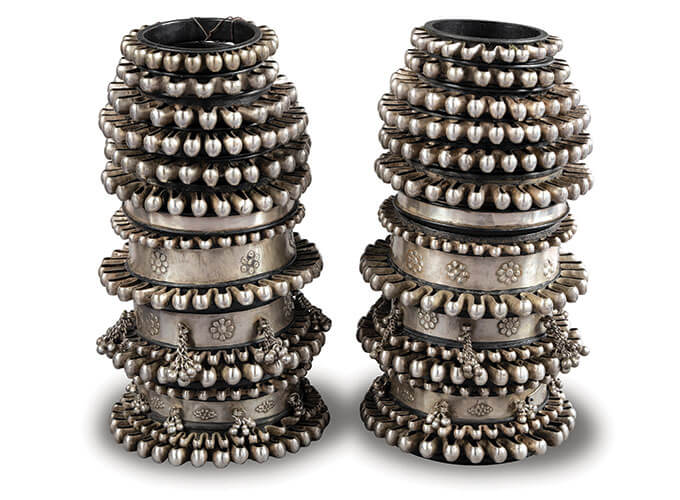
Thus, silver and gold, the metals most extensively used in Indian jewellery, are born of the earth and sky respectively, and are symbols of the two brightest heavenly objects—the Moon and Sun. They occur in their native form in the earth and are charged with manifold energies. Both metals have a high semiotic status in the cultures and lives of the tribal, peasant and nomadic communities. The moon played a life-sustaining role in two important ways: first, as climate predictor—forecasting abundant rainfall or dry weather, while the moon cycles defined good or bad harvests. Second, as a symbolic soulmate to water: the moon symbolized water, precious to agricultural communities and to itinerant travellers as they moved across arid deserts. In the darkness of night, silver jewels reflected the light of the moon, illuminating and animating them on the body.
In communities where the health system functioned on natural remedies and relied on traditional and spiritual healers, silver often functioned as a barometer of health. While the metal itself is non-toxic, it turns colour when it comes into contact with some toxins. Thus, if silver jewellery turns blue when worn continuously, it could “indicate the presence of elevated levels of sodium” in the body. Studies have also revealed that silver is a powerful antimicrobial agent, with the ability to protect the body against infections, colds and fever, and aid in the healing of wounds. Many of silver’s health benefits derive from its electrical and thermal conductivity. According to scientists, “Positively-charged silver ions create a conductive field that reflects electromagnetic radiation away from the body, which stimulates the body’s natural conductivity and improves blood circulation, body temperature balance, and general well-being.” Thus, a piece of silver placed on the body’s energy pathways located in the arms, neck and even toes balanced all elements in the body. For example, bangles that covered the arms from wrist to the elbow, and from the elbow to the shoulder; tapering cuff bracelets, that protected the arm from the blistering heat of the Indian sun and cooled the body; hair ornaments that rested on the top of the head, such as the chak worn by Gaddi women of Himachal Pradesh, as also the massive necklaces that literally blanketed their chest and retained body heat in the cold, generating enhanced energy levels.
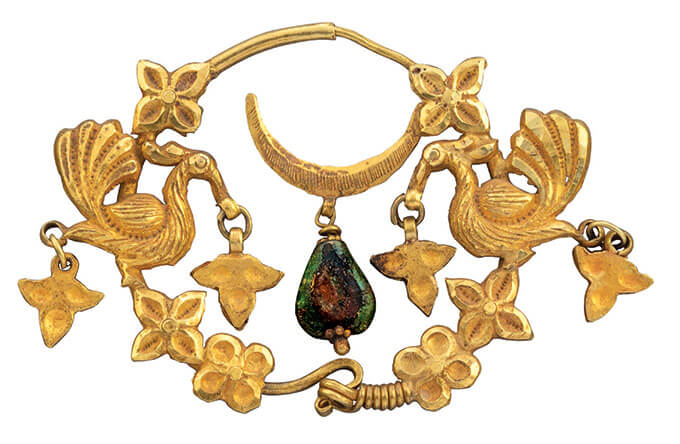
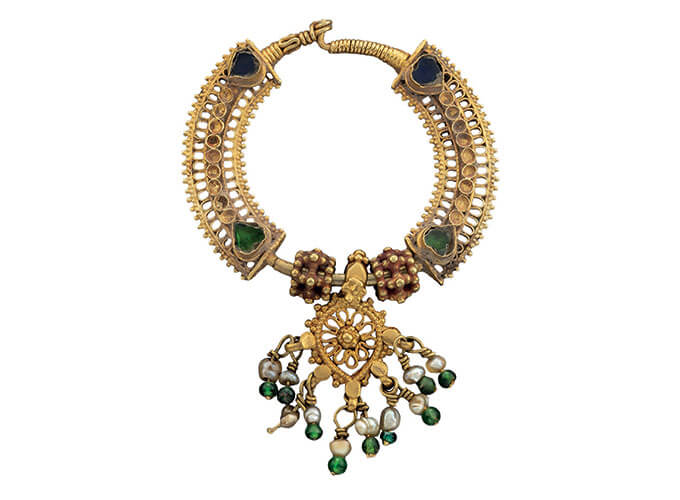
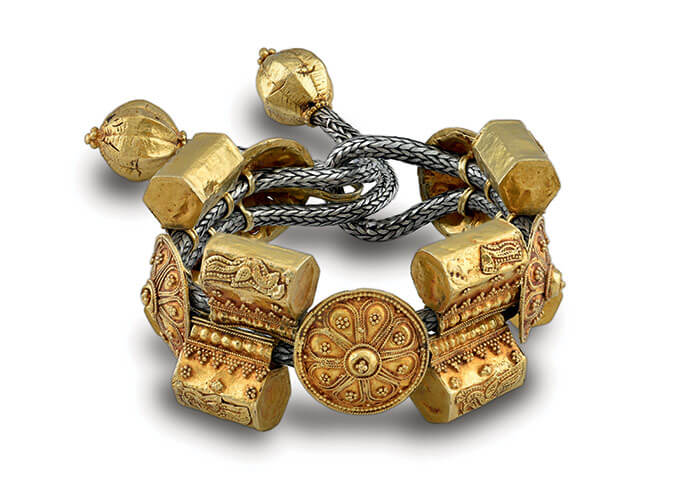
The yellow colour of gold is analogous to the effulgent sun, which is nourishing and life-giving, ripening the grains and fruits and regenerating trees, plants and flowers. Gold is considered pure and sacred, a gift of the gods with the power to purify whatever it touches. A piece of gold touching the skin at all times ensured longevity and facilitated the flow of prana, or life breath, in the body. The nose is the gateway for prana and, hence, nose ornaments were made of gold. Also, since pure gold is hypoallergenic and ideal for piercing delicate parts of the body, like the nostrils and septum, nose rings were mostly made of gold.