The Voice of Fashion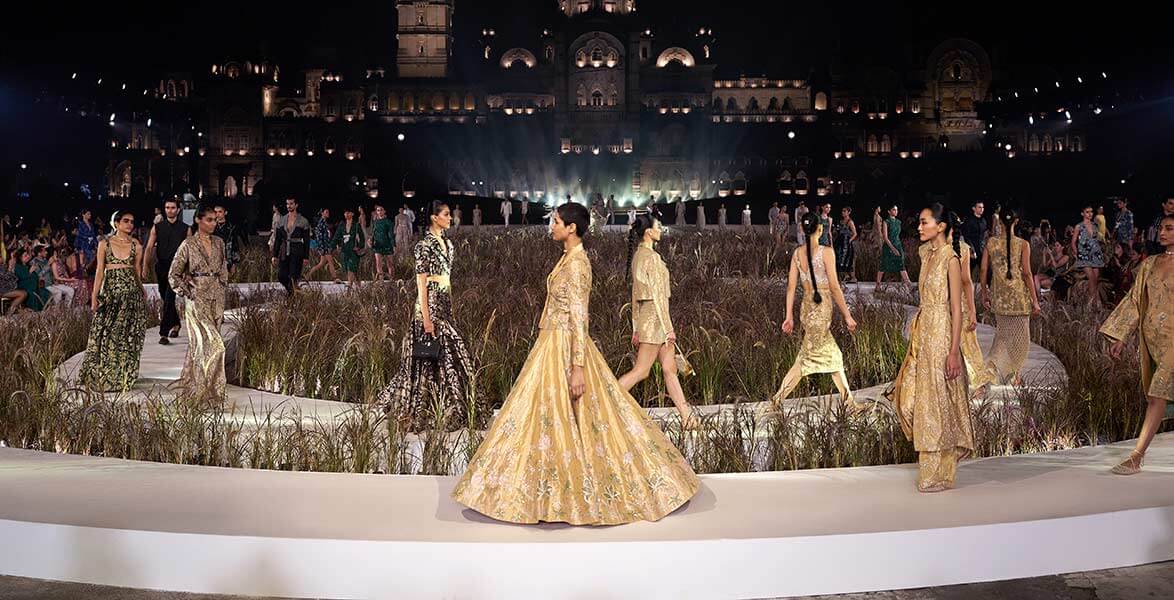
At Vadodara’s Lukshmi Vilas Palace, Anita Dongre staged Rewild as a layered story, with ecology, elephant conservation and craft. The clothes shared the spotlight
Anita Dongre’s Rewild—a fashion fundraiser for nature and elephant conservation—co-hosted with Radhikaraje Gaekwad at Vadodara’s Lukshmi Vilas Palace last week, was not conceived as a fashion show alone. It was designed instead as a day-long narrative, carefully paced and spatially choreographed, especially for guests invited from other cities—largely fashion media, stylists and influencers flown in from Delhi, Mumbai—to experience fashion as one strand within a larger cultural proposition.
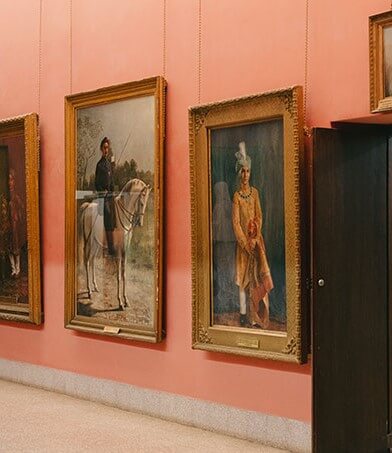
A guided walk through the Palace gardens, its stepwell and ancient banyan tree set the tone, with stories of antiquity and continuity narrated first by Radhika Gaekwad’s daughter Padmaja Gaekwad then herself took over as guests entered what is often described as the world’s largest private residence. The experience moved fluidly from the showering of rose petals on guests to viewing Raja Ravi Verma paintings, from armoury and bronze sculptures of a time gone by, to how women in royalty rooted for community and craft. From past to present, the story established lineage as setting and subtext.
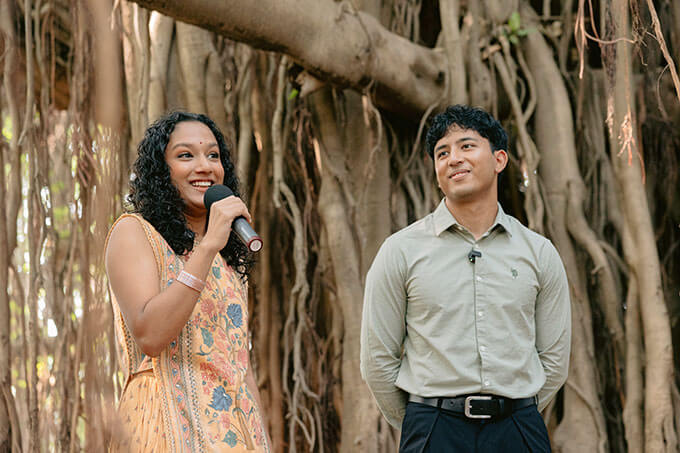
Fashion for Good
A brunch hosted by Rewild partner Fashion for Good followed, after which guests attended conversations on community engagement at the Gazra Café, run by transgender professionals. Far removed from the runway, these moments framed Dongre’s Spring Summer 2026 showcase as one gesture among many. Rewild was persuasive of the cause by stacking several ideas, people, philanthropic intentions and beauty.
At the brunch—attended also by representatives from animal welfare organisations working directly with Dongre’s conservation initiatives—dialogues emerged patiently. Without demanding attention, speakers addressed kindness and coexistence with animals for an ecologically positive worldview.
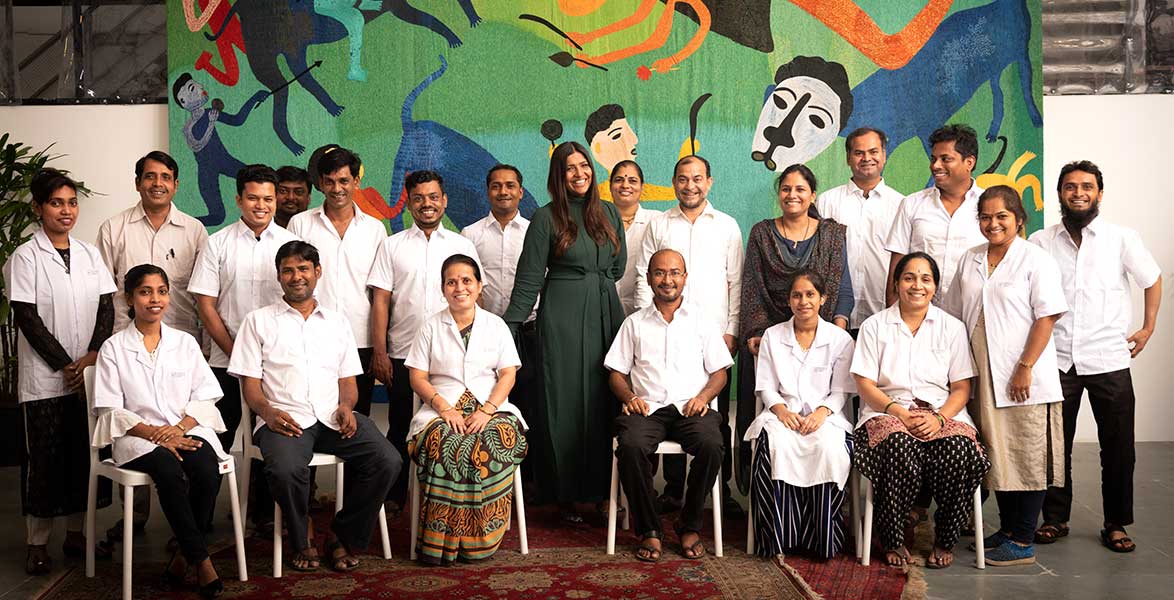
Later, before an on-stage conversation between Radhika Gaekwad and journalist and eco-feminist Bandana Tewari, a short documentary focused on craftspeople from the Crafts Design Society (CDS), speaking about dignity and validation that comes with independent livelihoods. The emphasis there was on labour, ethics and agency above stylish consumerism.
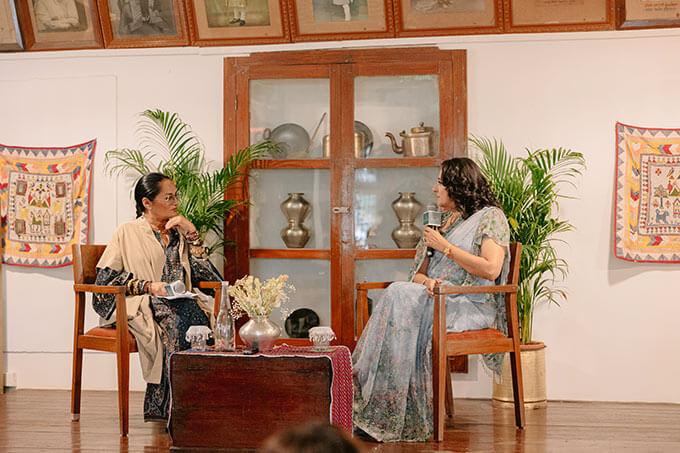
Reviewing Rewild and the Runway
By the time the Palace was illuminated for the evening show and models walked what was billed as Indian fashion’s longest outdoor runway, the clothes—assured, occasionally striking, yet familiar—were no longer the central message. Rewild had already positioned fashion as part of a broader moral architecture rather than its crown.
The project raises a larger question: what should Indian luxury look like—and how should it behave—when it wants to be seen doing good? How does it extend an authentic language of responsibility without surrendering the charms of spectacle, heritage and royal history that Indian fashion has been partial to?
This is where the reviewer’s task becomes complicated. Rewild does not present fashion as fashion alone, and therefore resists being judged on fashion’s usual terms.
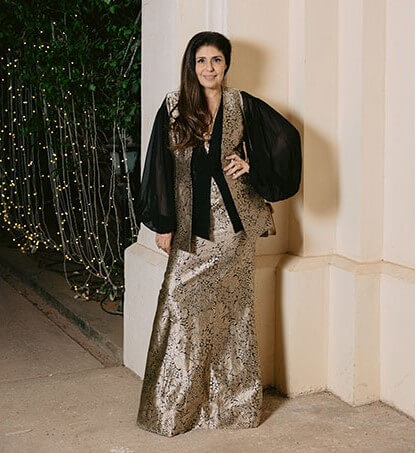
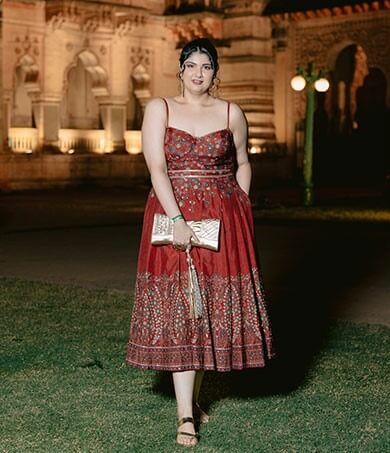
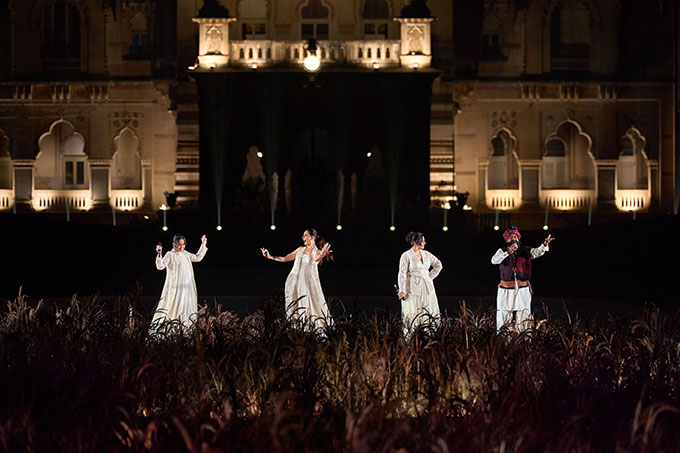
On social media, the event already exists as a cascade of admiration: glamour, influence, ethical credibility. Transgender equity, craft communities, conservation, couture—held together by two prominent hostesses, who bridge the worlds of royalty, activism and fashion. They offer a ready-made library of superlatives. Critical distance becomes harder to sustain.
The guest list reflected this dual investment. Alongside fashion insiders from Delhi and Mumbai dressed mostly in Anita Dongre, were the elite of Vadodara, everyone wore some kind of allegiance visibly. Grazing tables offered fine food alongside Gujarati delicacies, with non-alcoholic cocktails mixing raw mango, tamarind, rose and mint-basil in delightful flavours. Hospitality reinforced warmth and belonging.
It is Show Time
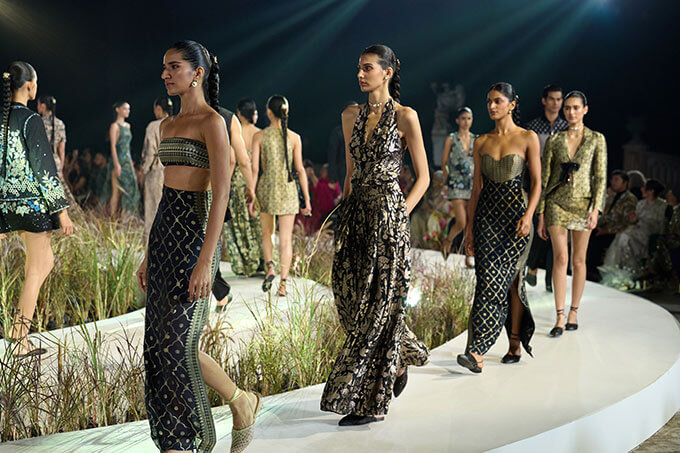
The show itself was robust and entertaining. Choreographed by Aparna Bahl Bedi and Anisha Bahl of Preferred Professionals, and styled by creative director Edward Lalrempuia, it was energised by a musical line-up featuring Raja Kumari, Monica Dogra and Kutch’s Mooralala Marwada, produced by Gaurav Raina, Komorebi and Karsh Kale. The atmosphere was celebratory, the foot tapping music leapt into the air.
Of the seventy-plus looks sent out on the coiled ramp, the opening capsule of whites was the clearest and strongest articulation of the Spring Summer 2026 vision. Lace, applique, net and sheer fabrics appeared in diaphanous blouses, short dresses, saris, men’s tops and fluid bottoms—light, and charming. From there, the collection moved through a wide range of crafts and textiles: hand-embroidered pieces by SEWA artisans, macramé, hand-drawn Pichhwai motifs, Banaras brocades. The silhouettes aimed to span generations, demographics and occasions.
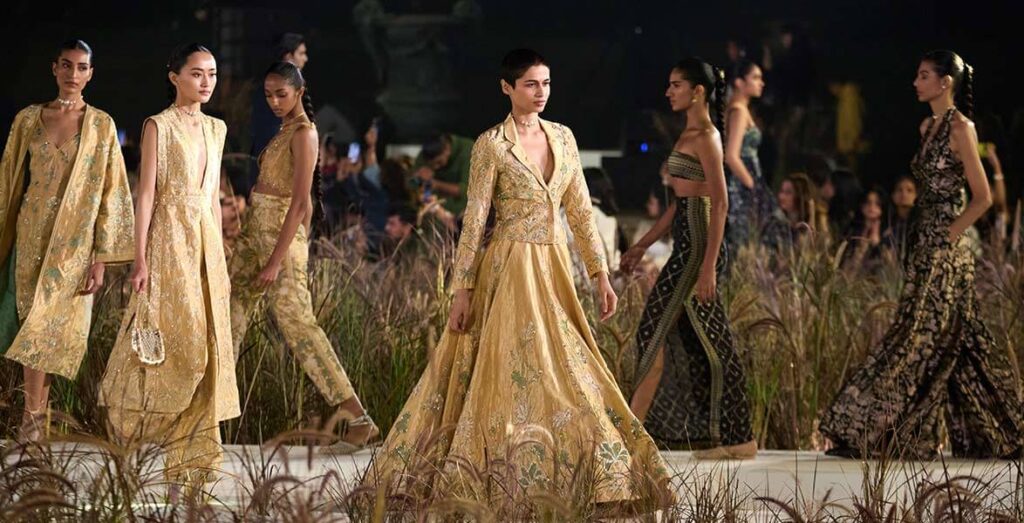
The palette ranged from sheer sunflower yellow to black-and-gold brocades to multicoloured embroideries. There were many attractive garments, but few that lingered in the imagination. The imaginative clarity of the opening whites did not entirely return with other capsules. Compared to Dongre’s previous Rewild collection, shown at Jaipur Palace in 2023, this outing did not have the same signature imprint. Here, the clothes were buoyed by everything that had preceded them.
The Halo
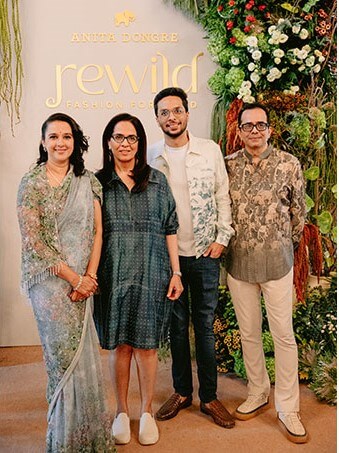
Perhaps the halo of the day-long experience—soft in tone, stoic in commitment—ultimately overtook the fashion itself. Dongre may need to explore ways of allowing fashion to assert its own impact, even as she continues the demanding work of being the karmayogi-in-chief of the Rewild story.
She is, after all, no designer experimenting with meaning for the first time. Dongre and her company, including CEO Mukesh Savlani, have consistently translated ideas of kindness into action, creating a model for ecological philanthropy and elephant dignity that sits within fashion’s realm. As the brand expands internationally, with the next generation—represented by Yash Dongre, President of the House of Anita Dongre—clearly invested in the journey ahead, Rewild functions with clear goals.
The project raises a larger question: what should Indian luxury look like—and how should it behave—when it wants to be seen doing good?
What we must remain attentive to is how inheritance, ecology, labour, inclusivity and ethics can sometimes overpower design itself. Lukshmi Vilas Palace—with its Raja Ravi Varma paintings, stained glass art and layered histories—is not mere décor. It is an ideological destination, positioning sustainability as lineage rather than a press release.
Rewild deserves to be observed gently. Its ethical scaffolding, its most persuasive force, does not peak on the runway. It resides instead in context—carefully assembled to endure beyond the evening’s applause.