The Voice of Fashion
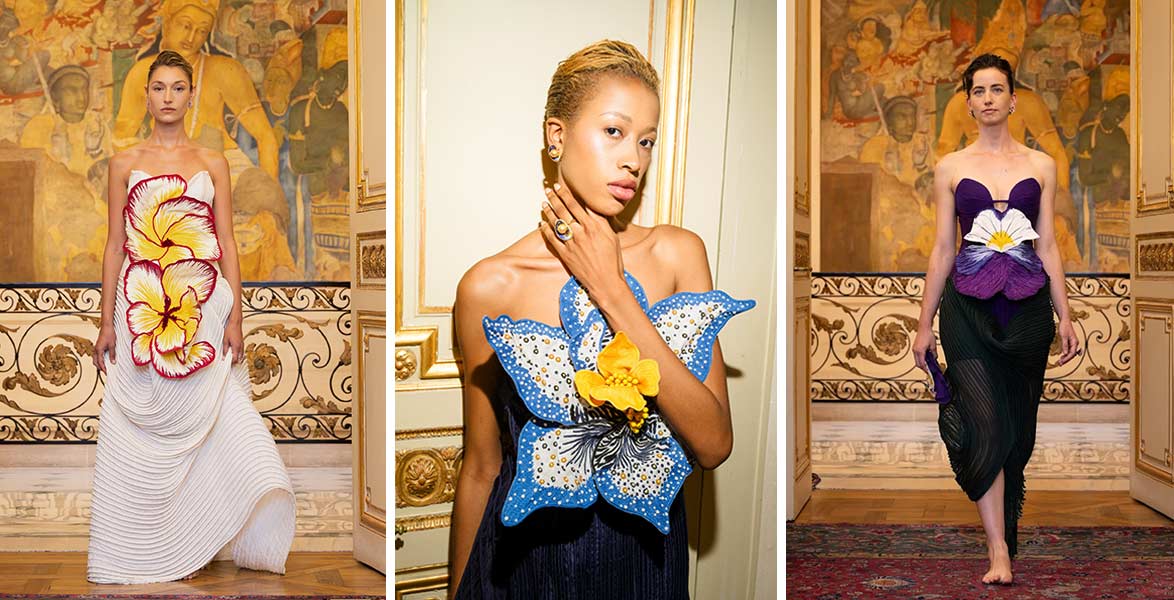
At Swayam, shown alongside Paris Haute Couture Week at the residence of the Indian Ambassador, the textiles spoke more eloquently than the collection.
The cloth spoke before anything else did. As did Vaishali S’s signature cording—her ingenious technique that continues to push Indian handloom into sculptural territory. Presented at the Residence of the Indian Ambassador in Paris alongside Haute Couture Week, earlier this week, Swayam reaffirmed why Vaishali is one of Indian handloom’s steadfast champions.
Her textiles retained their grain, slubs and tactile irregularity even as they were coaxed into tough silhouettes through cording, pleating and textile engineering. There was no attempt to imitate the fluidity of European satins, nets or lace. The fabrics remained Indian, carrying the clarity of their weave into couture. That confidence was Swayam’s greatest achievement.
But in comparison to the eloquence of the cloth, the collection struggled to keep up.
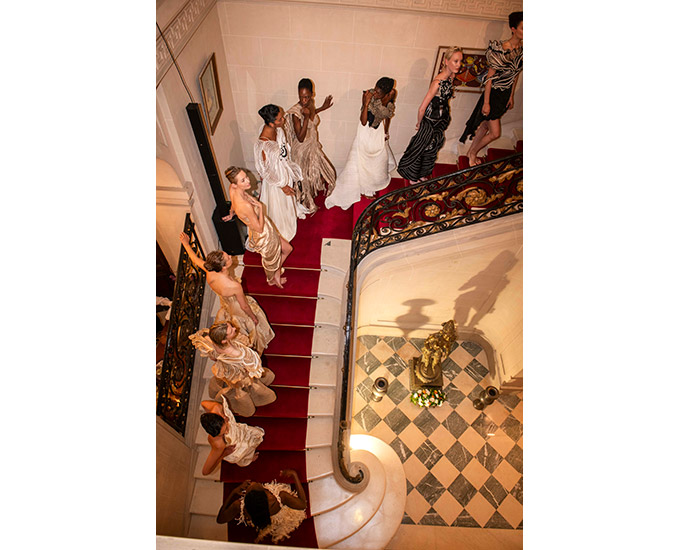
Built around the Sanskrit idea of Swayam—becoming through one’s own being—the collection unfolded as a journey from seed to bloom. Yet this symbolism was rendered with literalness. Flowers appeared repeatedly across bodices, corsets and sculptural forms until they could be seen more as illustrations on the collection’s first draft look book and sketches rather than metaphors.
A few pieces were strikingly beautiful. But overall, there appeared to be a gap between the integrity of Vaishali’s textile practice and the evolution of her design language. Instead of discovering new meanings of Swayam, the floral vocabulary reiterated the same idea through different constructions.
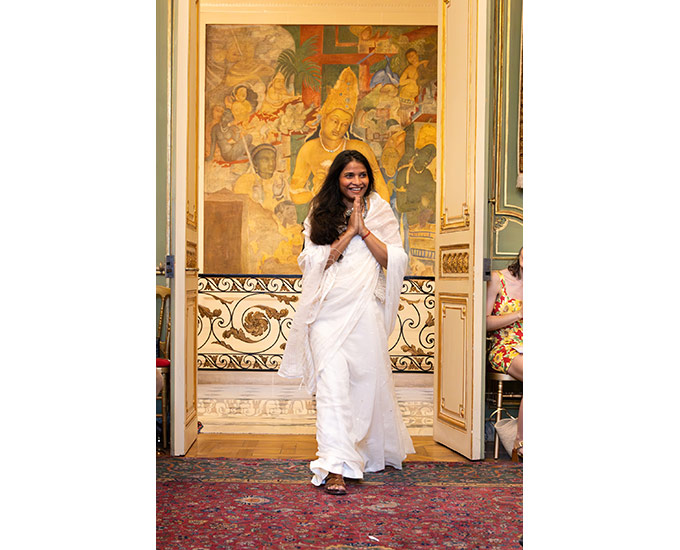
Technically, there was much to admire. Vaishali’s manipulation of handloom remains one of the most distinctive couture signatures to emerge from India in the past decade. But technique and emotion are not interchangeable. Watching the collection unfold as I sat there, my eye repeatedly paused at the construction of garments, but seldom lingered on silhouette. Even some beautiful Ikats, despite their richness, dissolved into the construction rather than asserting an identity of their own.
The collection also occupied an uncertain aesthetic territory. It was rooted in Indian textile traditions but without a vocabulary that can join couture’s wider global conversation. The result was neither an exploration of contemporary Indian dress nor a reimagining of couture through Indian textiles, but something suspended between the two.
The Challenges of Restraint
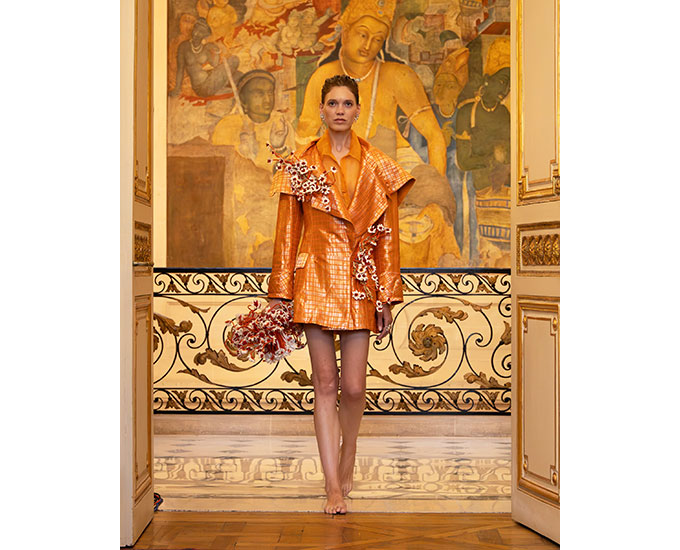
Some looks also suffered from disproportion. Oversized floral interventions and three-dimensional corded forms occasionally overwhelmed the body particularly when perched atop fitted bodices and close-fitting skirts. They created top-heavy silhouettes. Wherever restraint prevailed, the collection was considerably stronger.
Restraint, though was present in the presentation in other ways. Barefoot models and near-complete absence of accessories were intelligent styling decisions, allowing the clothes to occupy the foreground without distraction. Models without footwear is an aesthetic Vaishali has embraced before and one that continues to work.
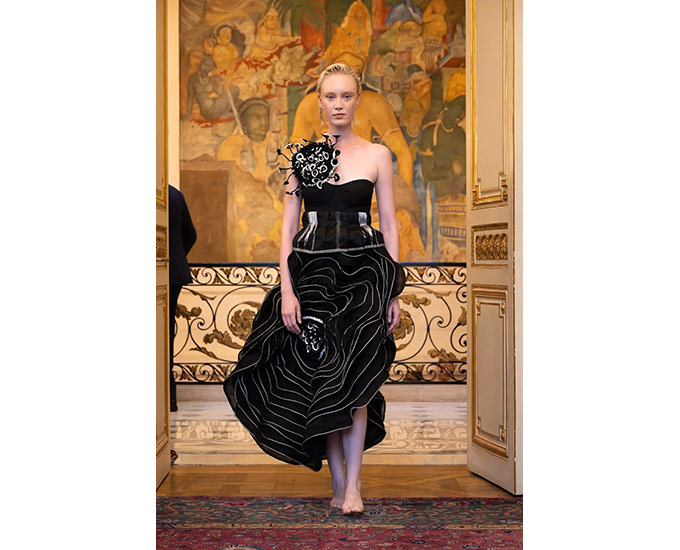
Less successful, however, was the choreography. The measured pace of the models generated little dramatic tension, even as Indian instrumental music attempted to lift the mood. Casting, too, felt like a missed opportunity. This was a privately produced presentation rather than an official Fédération show and thus the casting was entirely the designer’s own decision. In a collection so invested in Indian textile heritage and the Sanskrit idea of Swayam, the absence of Indian models felt curiously disconnected. This is not an argument for token representation. It is an argument for coherence especially as Swayam spoke insistently of India.
In many ways, Vaishali has already won the argument that Indian handloom belongs on the global couture stage. The more important question now is what new aesthetic territory her handloom couture can still discover.
Banner: Vaishali S’s Swayam at Paris Haute Couture Week, built around a recurring floral motif.