The Voice of Fashion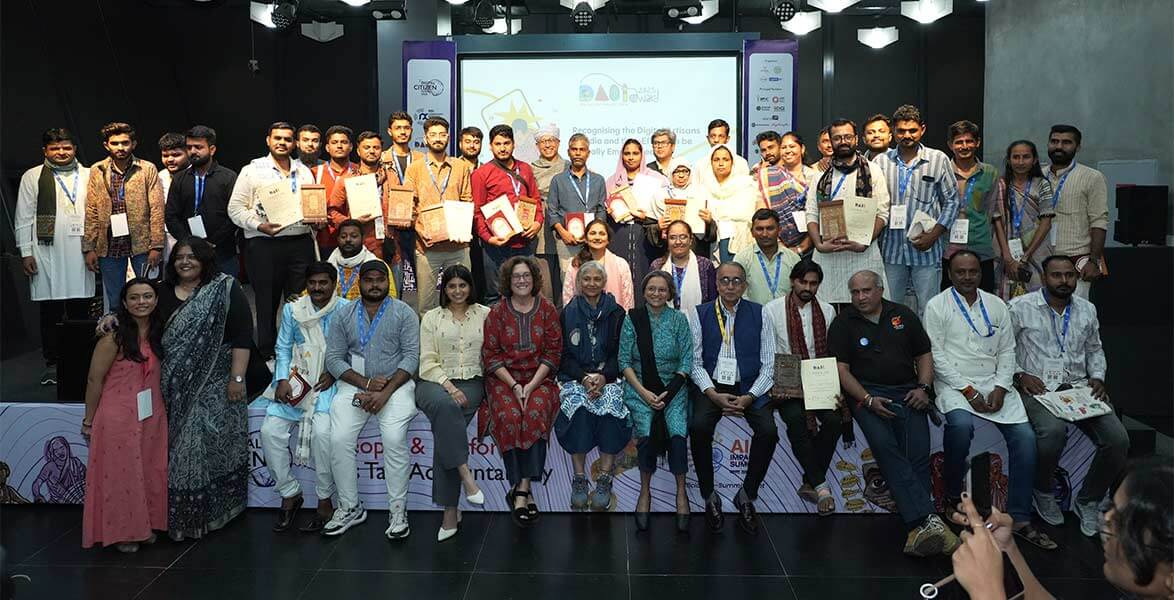
The second edition of the Digital Artisans of India Awards recognised Indian artisans for creative tech—a long overdue levelling in the craft economy. It signals why younger craftspeople are not deserting traditional skills
The emotional wrap at the conclusion of the second edition of Digital Artisans of India Awards in Hyderabad last week was not about nostalgia. It was about dignity, possibility and parity. About the fast closing gap, that would formerly gape open between urban designers, often hailed as artists, and craftspeople based in villages, tagged as skilled, but in a patronising way, surrounded by the rhetoric of labour. Their possibilities were clouded, if not eclipsed, by their real disempowerment—limited or no digital literacy. Especially in an era where digital is a religion and a dependence.
The Digital Artisans of India Awards—established last year by the Digital Empowerment Foundation (DEF) founded 24 years back by Osama Manzar, now a globally acclaimed authority in developmental knowledge and enablement— had a few “simple” goals. “To acknowledge and boost the long-held resilience, knowledge, crafts and skills of artisans and create a cohort, a community of digitally enabled artisans,” says Manzar. He points out that the artisan community of India is bigger than populations of several European countries. They need to be enabled to self-promote themselves in the age of technology.
The Ecosystem Behind the Awards
DEF’s other arm Digikargha, instituted in 2009, has been relentlessly working to revive Indian handlooms by integrating digital tools, skills and platforms to build sustainable livelihoods, preserve cultural heritage in the direction of inclusive growth. It currently covers 18 states and union territories, more than 85 districts and has digitally empowered more than 1 lakh artisans.
These awards lean into that architecture. They take forward the intent, story and persistence of DEF and have been instituted in partnership with Creative Dignity (CD). Meera Goradia, the chair of CD, explains how her platform helps DEF with ground level mobilisation for the awards and digital training modules so that artisans can actually apply. She adds that it must all lead to their network expansion, monetary support, recognition and access to points of contact, preferably in their own region, so that they can find gainful collaborations.
The awards constituted in five categories—for Traditional Art, for Inclusivity, for putting India on the Global Map, for Sustainability and for a Start-up— revitalised the palpable excitement, and learning curves around potential, sale, photographic aesthetic, online commercial viability and “recognition” that artisans look for.
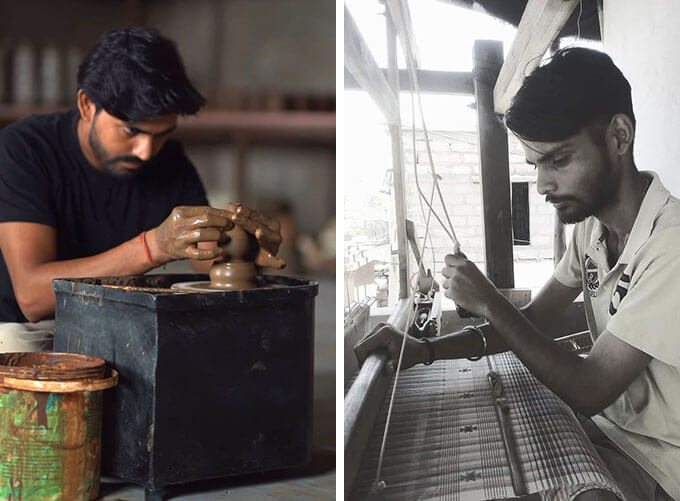
“I belong to a very small village in Bhujodi, and Kutch Weaving is a craft that I learnt from my dad and my brother. Initially, when I was younger, I was fascinated with what my dad would do with the thread and weave, so I started helping out. And now, I’m here, at a stage with global members, and being recognised as the first prize winner of Digital Artisans of India Award. It’s unimaginable!” says Ashwin Siju, the first place winner.
Each category was assigned three prizes—winner, first and second runner up. The first prize winner gets Rs 1 lakh, the second takes home Rs 75,000 and the third Rs 50,000. When it comes to a tie, the jury gets to review and decide, often (as this writer witnessed as part of the honorary jury), taking pains to find the real “winner” considering gender, patriarchy, and the ability to cut through existing rural challenges.
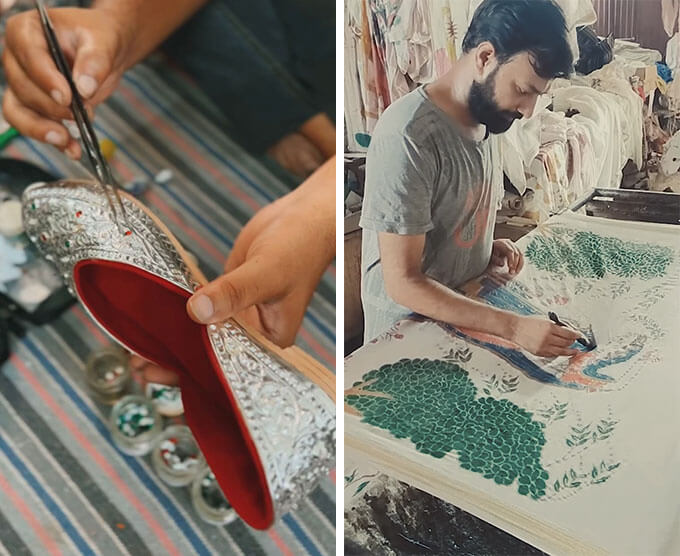
Much like second place winner Aafiya Khan, who comes from a family that has been crafting silver footwear in Lucknow since 1972, essentially a male-driven craft tradition. “This (making silver footwear) has been the story of my family for generations and I’m the only woman taking it forward, so this moment is special for me. It motivates me to do better, to preserve my craft better and note that my business can boom if I walk hand-in-hand with digital,” said Khan.
But it is not only about honour and recognition, it is also about financial support, says Manzar. “The fact that the awards were planned in Hyderabad, the city of start-ups, itself was a considered thought. This is to create an elite community of digitally-enabled artisans. And where and how they are recognised and rewarded, makes a difference,” he says.
While Goradia feels that the platform needs to go bigger, and open interfaces with prominent stakeholders in the market, the real wins lie in how artisans are learning to use digital knowledge as a “tool” to further their traditional skills. She cites the example of an artisan who used the QR code to create a feedback form for his customers so that he could improve his product. He found himself too busy and deluged with orders to take oral feedback and this became a tool.
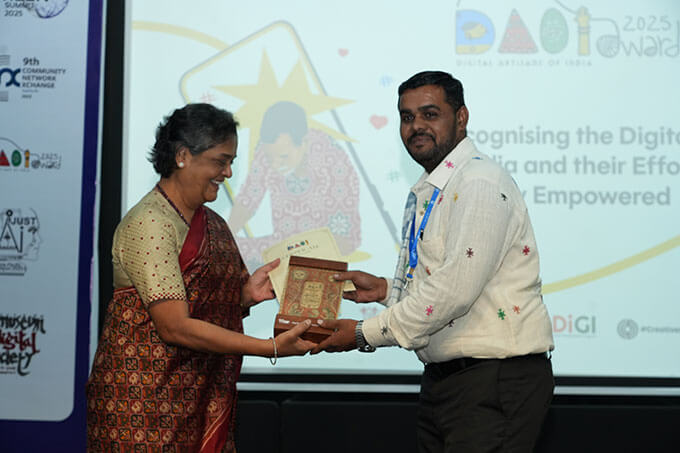
“Before this we used to be integrated with digital, but now we truly understand the power of digital. My biggest order till date has come from digital and I am so proud to be here,” said Ishver Singh Prajapat, as he won the third place at the ceremony. Prajapati is a clay pottery artisan from Ramgarh in Jharkhand, whose family has been in the craft for 15 generations.
“The fact is that the frequent lament that young people are no longer interested in traditional crafts as makers and creators is being reversed—that’s the big win,” says Manzar. They want to continue enabled as they are with social media, Instagram reels and sales, online businesses, QR codes and other related tools that technology endows.
“The real win is a sense of samanta (not just equality)—a deeper parity where artisans no longer stand behind the creative economy, but beside it.”