The Voice of Fashion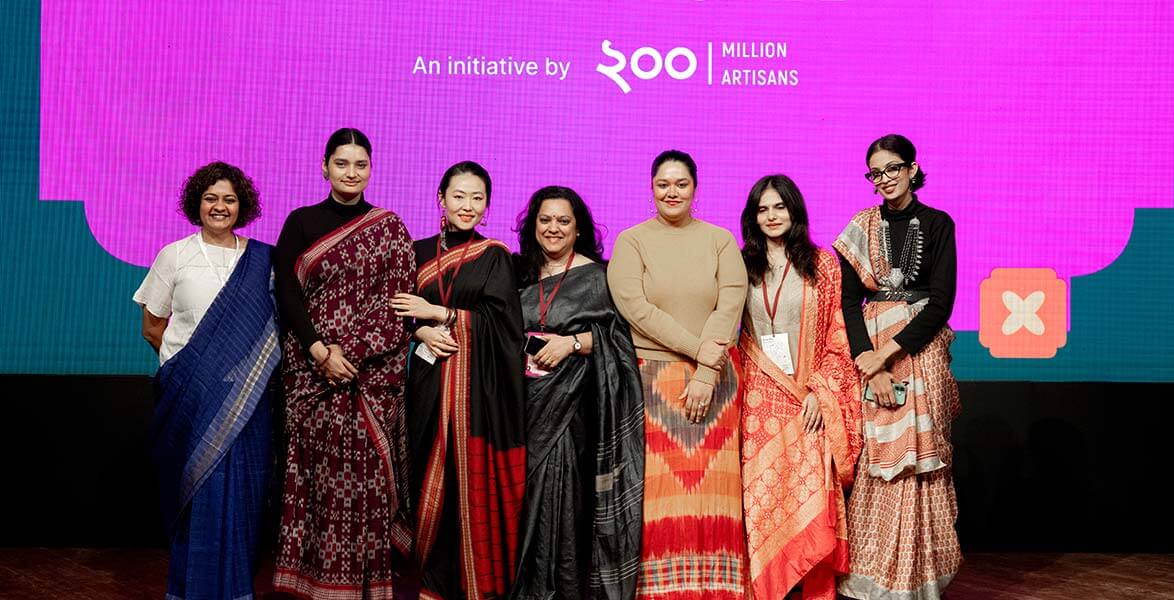
The founder of 200 Million Artisans on perception as the sector’s biggest barrier, Kula Conclave going on pause, and what it takes to build a serious economic future for India’s handmade enterprises
Almost five years after she founded 200 Million Artisans (200M), Priya Krishnamoorthy inhabits a certain kind of leadership that remains unique in the Indian framework—especially among those who enable the country’s artisan economy. Her persona mixes openness with resolution, just as her work does. Since 2020, what began as a COVID-relief experiment grew into 200M, an ecosystem that holds together data, capital, research and community-building for India’s handmade economy.
Kula Conclave, sometimes mistaken for the organisation itself, is only one of its three platforms, alongside Business of Handmade and Kula Innovate. Collectively, this is a bustling, plus-sized community of investors, start-ups, artisans, young creators, established karigars and voices of heft in data, capital and research. Intent too. The kind of infectious intent Krishnamoorthy brings to her crusading vibe, is reflected in her distinct saris, in her selection of handlooms and the way she drapes them with longer blouses, paired with sneakers, signalling a woman on a purposeful trek.
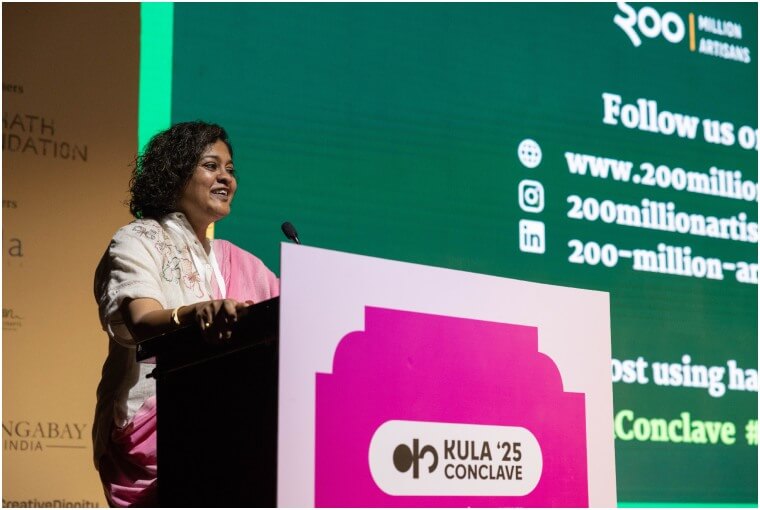
In a sector accustomed to benevolence, nostalgia and soft storytelling, her presence is exacting—measured in language, and influential when she addresses audiences, while getting culture, capital and policy to speak to one another.
At the Jaipur edition of the Kula Conclave held earlier this month, when she and her team announced that Kula was going into a pause, it came not from a place of retreat, but of strategic review. A deliberate slowing down to build infrastructure and reimagine value beyond the optics of an annual gathering.
In this interview, Krishnamoorthy—former journalist, arts manager and ecosystem builder—who understands storytelling only too well, speaks about perception as the sector’s greatest structural barrier and the urgency of moving handmade beyond charity narratives. And why the leadership in craft today requires not sentiment, but stamina, hardy systems and the ability to hold many communities at once. Edited excerpts.
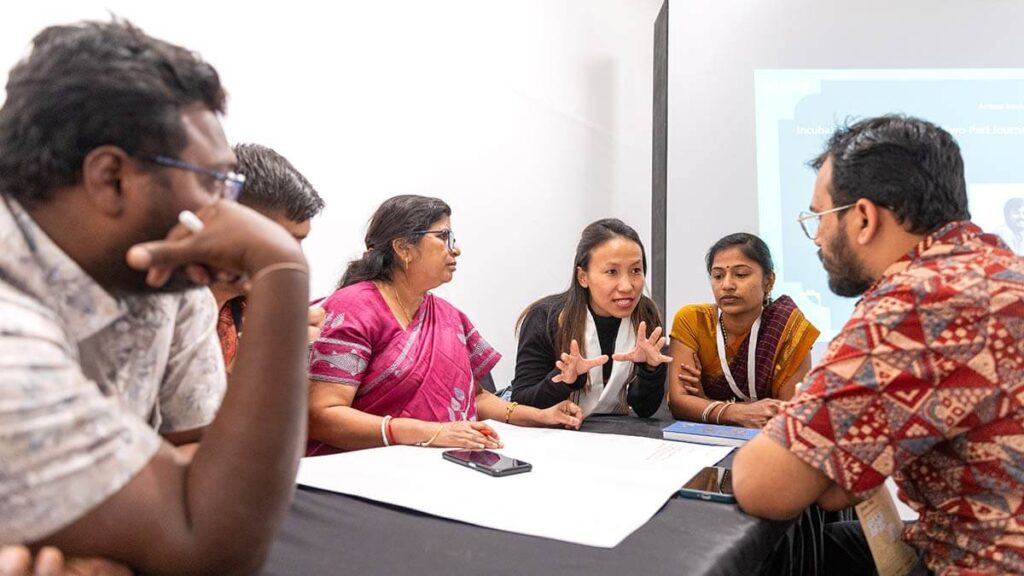
You started 200M because you saw a massive unmet need—artisans who lacked access to capital, networks, and visibility. Looking back now, what is the one story, enterprise or artisan community that best embodies the transformation you hoped 200M would catalyse?
Many stories stay with me. The ones that best capture the transformation 200M hoped to catalyse are the small, human moments. Tiny shifts in perception about the sector and the people who drive it every day.
Like, when a student says they were first introduced to craft by their professor through Business of Handmade. Or when an entrepreneur breaks down in tears because Kula Innovate made them feel truly seen for the first time in their journey. Or when founders go on to win awards or raise capital. Or when a capital provider says they feel more hopeful about investing in the sector.
More than the outcomes, building and co-creating these platforms has been deeply rewarding.
The business of handmade is rarely seen as a serious investment destination. What do you see as the greatest structural barrier that still prevents this from being mainstream?
The biggest structural barrier is perception, which shapes how the sector is supported. Craft and handmade are still seen as a collection of products, or a nice-to-have layer in capital and policy strategies. Not as a way of working. Not as innovation. And not as a serious economic sector. This framing misses the point. Craft is experiential by nature and offers an opportunity to reshape how we think about production, consumption, and value. Industrial applications of craft can coexist with niche practices that belong in museums. If India has over 3,000 craft forms, there are at least 3,000 different ways of building enterprises around them. This narrative gap is reinforced by a lack of data and evidence. Without credible signals on performance, risk and growth, craft-led businesses are labelled niche by default. That perception limits investor and funder confidence, weakens policy support, and keeps handmade enterprises outside mainstream capital conversations.
There is also a deeper mismatch at play. Craft-led enterprises are decentralised, community-rooted, and asset-light. They grow through trust, skills, and distributed supply chains, not rapid scale or centralisation. But most investment frameworks are built for very different kinds of businesses, often centralised factory-led models. Platforms like Kula help bridge some of these gaps. But for lasting change, the sector needs its own playbooks for capital, measurement, and growth.
How do you balance the tension between preserving traditional craft methods and pushing for innovation, scalability or market relevance?
Traditional craft has always evolved. Techniques, materials, and motifs shift with time, markets, and context. ‘Handmade’, while an important part of the impact story, should not amplify poverty-linked narratives. Handmade, handcrafted, and artisanal should stand for excellence, new ideas, innovation, co-creation, opportunity, and collective well-being. This is central to building sustainable, future-ready business models. Craft-based enterprises support millions of livelihoods in India, the majority of whom are women. Yet, only one in ten craft-led MSMEs (Micro, Small, and Medium Enterprises) have easy access to formal, fit-for-purpose capital.
Innovation does not replace tradition. It begins with better tools, cleaner materials, improved working conditions, stronger design, better storytelling, and expanded market access. Access to the right capital is a core part of this innovation ecosystem. Craft-led enterprises require different forms of capital across their lifecycle, including early-stage risk capital, working capital, growth capital, and dedicated support for design and R&D. Capital providers, policymakers, and institutions must also invest in the infrastructure required for the future.
Scalability in craft looks different. It is about enabling more people to participate meaningfully across distributed systems. Today, the average age of a weaver in many regions is 45 and earnings often fall below ₹200 a day. An average monthly income of ₹5,000 is simply not viable. Creating aspirational pathways for the next generation of artisans, makers, and creative producers is essential to building sustainable and scalable craft-led businesses. Without this, we continue to spend time and resources rebuilding skills that already exist. These skills and knowledge systems, and the communities that carry them, are India’s competitive global advantage.
At the recent Kula Conclave in Jaipur, you signalled that Kula will take a pause, but work will continue in some form.
Kula Conclave is taking a pause after this year’s edition so that 200M can step back and build intentionally for the next five years. Most people don’t realise that Kula Conclave is only one of our three platforms.
This pause allows us to rethink how we deliver value beyond a single annual event and how we bring the idea of kula—meaning community, kinship, and family—to more people. It is also about building the right infrastructure so craft-led enterprises can thrive at scale. For us, this is not a stop. It is a transition.
Over this period, we are prioritising storytelling and evidence-building through Business of Handmade, which remains the foundation on which Kula was built. At the same time, we will continue to build on the ideas, provocations, and early experiments seeded through Kula Conclave and Kula Innovate over the past three years. This pause is also an invitation to the community to step in, co-create, and help shape what comes next. While the format may evolve, the work of supporting the handmade sector does not pause. The knowledge, networks, and capital flows we have seeded, I hope, will continue to grow, reaching more artisans, founders, and communities in the years ahead.
“More than the outcomes, building and co-creating these platforms has been deeply rewarding,” Krishnamoorthy.
Given your background as a journalist, arts manager and now social-entrepreneur, you understand the language of culture and the language of capital. For writers, critics, cultural commentators—what role do you think we can play in this shift?
Writers, critics, and cultural commentators shape how people see craft. As a trained journalist, I believe we carry a responsibility to frame narratives with care, caution, and nuance. Our stories need to move beyond charity-linked framing and lead with facts, research, and data, without losing their humanity.
Craft-based approaches are inherently gender-inclusive and often climate positive. Yet these dimensions rarely enter mainstream cultural or economic discourse. This creates a rich and urgent opportunity for storytellers.
There is also a clear need to change what we centre in our storytelling. We must highlight process, skill, labour, and systems, not just the final product.
As storytellers, we also need to locate craft within larger economic, cultural, and investment movements globally. We must move away from the ‘Save the Artisan’ narrative. Artisans are not mere beneficiaries. They are creative peers, potential clients and customers, and entrepreneurs who need an enabling ecosystem, not hand-outs.
Language plays a critical role in this shift. The words we choose shape value, influence capital, and inform policy. Good storytelling does not romanticise or flatten craft. It makes it legible, desirable, and investable.