The Voice of Fashion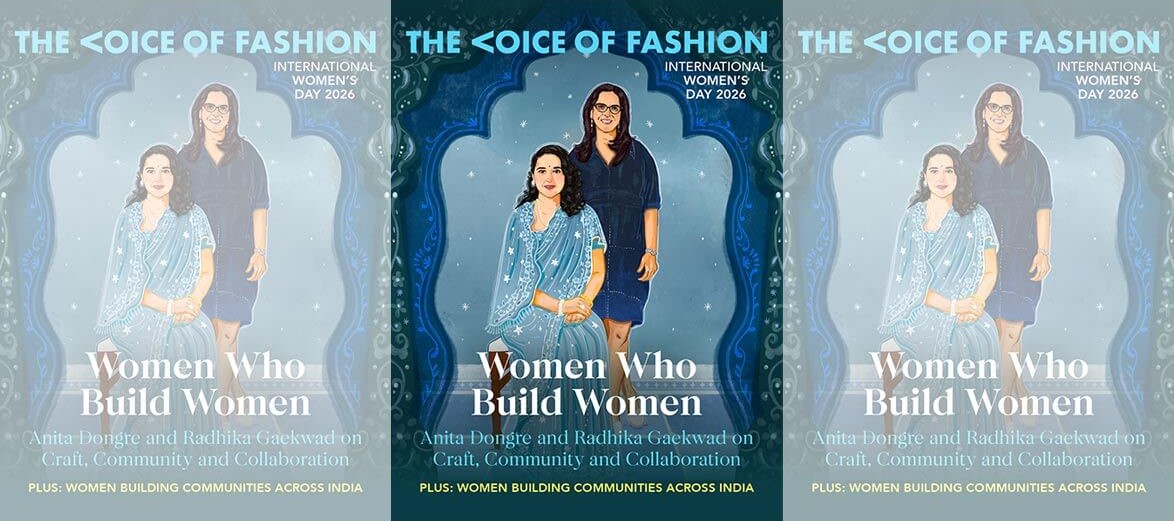
From craft economies to cultural platforms, Anita Dongre and Radhikaraje Gaekwad reveal how influence becomes meaningful when it creates opportunities for others
Bringing Anita Dongre and Radhikaraje Gaekwad together like this, far removed from the echoes of the Rewild show earlier this year in Vadodara, was an idea that took shape in one of the central halls of the Lukshmi Vilas Palace. Known as the world’s largest private residence, the Indo-Saracenic structure, designed by Robert Chisholm and completed in 1890, rises in ornate arches and stained glass that flooded its halls with afternoon light in January. It was here, over a lunch hosted by Fashion for Good, that we requested Dongre—a designer synonymous with democratisation, craft enablement and sustainability—and Gaekwad, her collaborator and co-host for the event, to stand together for a photograph.
In that moment, the story began to write itself. It was not merely about a designer and an erstwhile royal appearing together as a symbolic sisterhood. Nor was it simply about fashion’s relationship with craft and climate-conscious design practice. Or about how a social entrepreneur often addressed as “Maharani” deploys influence for community work. One in a self-designed minimal dress, the other in an embellished deep grey sari with crystals and embroidery, also designed by Dongre and chosen by Gaekwad. That obvious contrast would have been the easy narrative.
The real story lay elsewhere.
International Women’s Day arrives each year with familiar language—empowerment, resilience, representation. Yet, beyond the rhetoric the global media underlines lies a complicated question: who actually builds the communities that allow women to work, earn, learn and belong? In a world where climate change disproportionately affects impoverished women, where the persistence of sexual violence continues to reveal deep inequalities of power—even in nations once called leaders of the free world—and where political regimes such as the Taliban still debate women’s autonomy, the idea of collective support systems is no longer symbolic. It is life and breath.
Across India, communities—the roots and shoots of how we live, love, think and work—emerge through different forces. Some grow through enterprise and markets, others through patronage, institutions and social platforms where employment, insurance and protection are built into the system. Still others are sustained through the persistence of individuals who continue until a circle forms, until a sisterhood takes shape and people begin to work wing in wing.
Anita Dongre and Radhikaraje Gaekwad represent two expressions of this impulse. Dongre, among India’s most successful and respected designers, has built ecosystems around craft, sustainability and ethical fashion, working with women artisans across the country through organisations such as the Self Employed Women’s Association (SEWA) and skilling and tailoring initiatives. And We Rise, her 2019 initiative (AND stands for Dongre’s democratically priced ready-to-wear brand), documents stories of ordinary women rising above their circumstances. She considers this an extension of her belief in the power of sisterhood and mutual learning, both in rural and urban settings. “It is still about And We Rise,” she says for this story.
In more personal notes, Dongre has spoken about frugality and material minimalism as ways to rethink her personal relationship with consumption. Smiling easily, her eyes crinkling behind her glasses, dressed in sparse silhouettes with little ornamentation, and practical shoes, she embodies a quiet discipline. A new grandmother with a long and deep maternal instinct for nurturing communities, Dongre has—alongside her brother Mukesh Sawlani, the company’s chief executive officer, and son Yash Dongre, who leads its international expansion—extended her work far beyond the runway. Her commercial success in bridal couture sits alongside this work rather than competing with it. Not surprisingly, one of her most significant initiatives is called Grassroot.
Heritage as Instrument
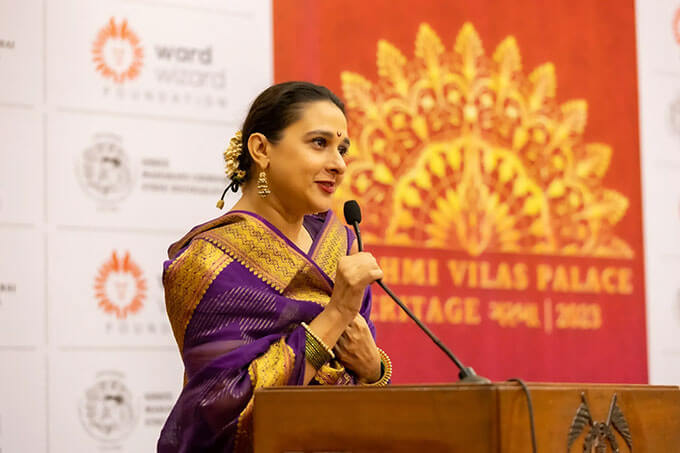
Gaekwad, on the other hand, belongs to the erstwhile royal family of Baroda. Heritage is her chosen instrument. She has built a circle of influence with articulation and privilege, drawing on an instinctive ability to communicate. Both verbally and non-verbally.
Textiles, gajras, flowers, decorative ensembles, footwear, jewellery, hair and makeup—even reviving a heritage Garba festival—form part of the vocabulary of shringar through which Gaekwad crafts her public presence. Everything she wears appears carefully chosen, yet what distinguishes her most is not adornment but the attention she pays.
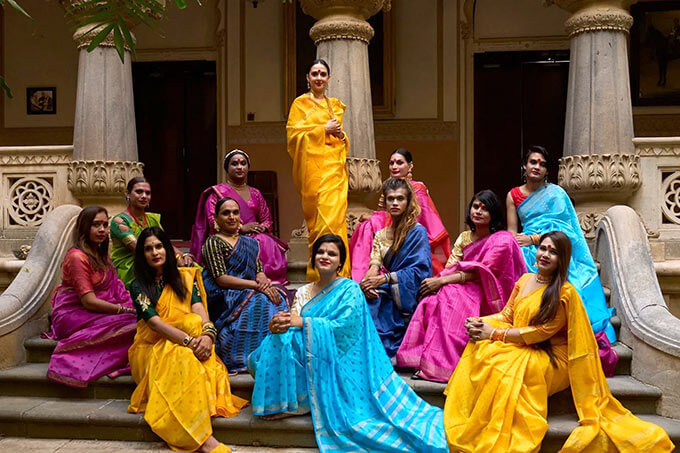
She runs and revitalises Maharani Chimnabai Stree Udyogalaya (MCSU), a century-old institution focused on skill development and livelihood for women. She helped launch Gazra Café, Gujarat’s first café employing LGBTQIA+ staff to create dignified work and social inclusion. She works on craft revival and artisan platforms and promotes heritage textiles like the Baroda Shalu, including through Urja, an initiative that began during the pandemic.
Dongre and Gaekwad may occasionally collaborate as they did earlier this year, but their approaches reveal two complementary ways in which influence can translate into opportunity.
This story, ultimately, is about how and why they build communities.
The Sisterhood Economy
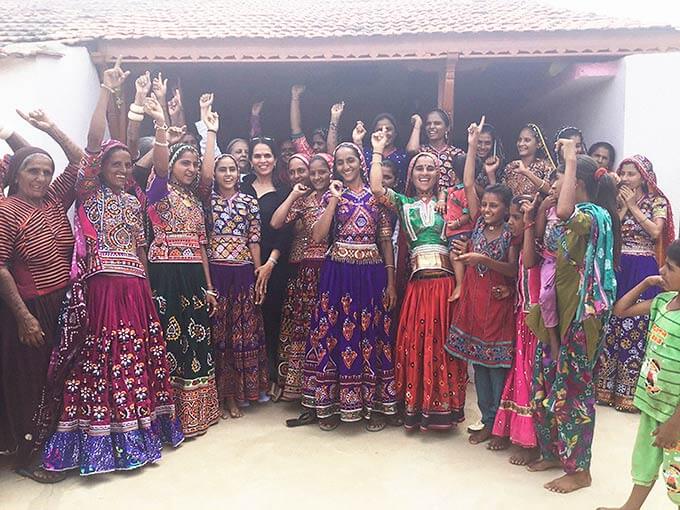
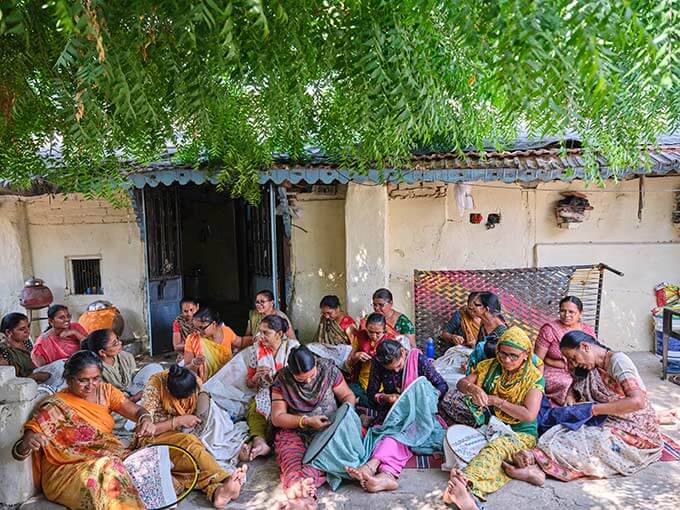
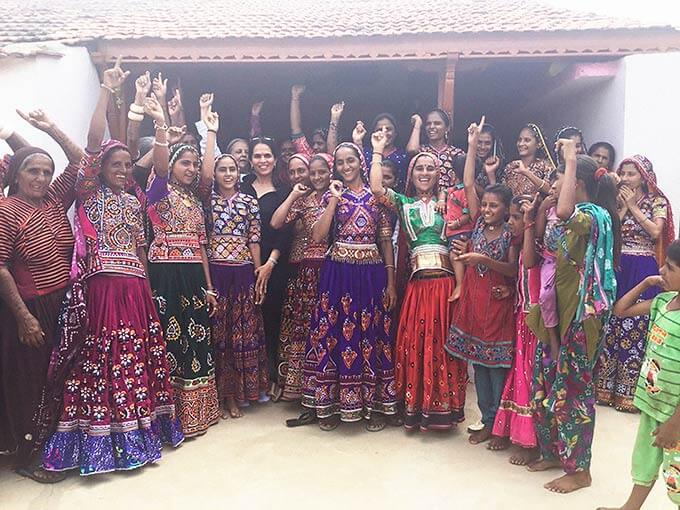
For Dongre, craft communities are not simply supply chains. They are relationships built slowly over years of working with women who sew, embroider and learn together. Raised in Jaipur, in a large family with five siblings, she often describes these networks as a “sisterhood”—a word that captures both the discipline of collective work and the emotional bonds that grow within it.
She recalls an episode involving the women of SEWA that has stayed with her. During a flood in Gujarat, work schedules were disrupted and delivery timelines seemed impossible to meet. Yet the artisans stayed up late into the night, finishing intricate embroidery pieces meant for the opening of her New York store. “They kept everything aside to finish my pieces in time,” she says with admiration. “Especially the women of SEWA.”
What moves her is their ability to adapt. Over the years the artisans have shifted from working on heavier cotton fabrics to finer materials that suit Dongre’s designs, especially couture. The learning, she says, goes both ways. “I learn so much from them, and from me they have learnt the value of hard work despite success. They keep asking me: why do you work so hard when you have everything?”
Dongre’s company has trained women in several villages in Maharashtra, organising them into small tailoring groups that allow them to earn from home. In the age of smartphones, pride travels quickly. When a celebrity appears wearing one of the garments, Dongre’s team sends the image back to the artisans on WhatsApp. The response, she says, is immediate: pride, excitement and the recognition that their labour has travelled far beyond the village where it was made.
Whether in New York, Gujarat or a small village in Maharashtra, Dongre believes the dignity that comes from earning one’s own income can change how women are seen within families and communities. The sisterhood, in other words, is also an economy—one built not only on skill and wages but on mutual respect and shared aspiration.
The Power of Listening
For Radhikaraje Gaekwad, the path begins with listening. Her communities emerge through cultural platforms, patronage and the steady work of paying attention to people’s stories.
“The biggest tree I have sown is that of communities of women,” she says during a follow-up conversation on video, weeks after the Rewild show in Vadodara. “One cannot be self-reliant, self-empowered or self-confident by living alone. It is about carrying women with you, else you will be isolated. I believe in the power of shared journeys.”
The metaphor of the tree is not incidental. As guests were led through the grounds of the Lukshmi Vilas Palace in January, her daughter Padmaja had pointed toward one of the largest banyan trees in the city, its branches bending toward the earth as if in reverence. “My mother can still climb that tree with us,” she says with a smile, drawing attention to the cool shade beneath its canopy—a natural shelter.
Dongre and Gaekwad arrive at community-building from very different worlds—one through enterprise and craft economies, the other through heritage, patronage and cultural platforms.
“‘I want to hear your story,’ I tell the people I meet. I am genuinely curious,” says Gaekwad. Listening has been her most reliable tool in building communities and identifying people who need support and then aligning them with the right cause and opportunity, so that nothing is forced or haphazard. “To listen without judgement is the first step to understanding people,” she says.
She speaks about this instinct, acknowledging the privileges she was born into. “I come from a royal family and as a child I would accompany my grandfather on his drives. He would stop again and again to listen to people’s stories. I could see how people responded to being seen, heard and felt.” Being the daughter of an IAS officer and growing up with a mother who could relate easily across social classes, she says, further shaped her understanding of communication. For Gaekwad, this means paying attention not only to spoken words but also to the silences between them.
Using Influence to Build Communities
Dongre and Gaekwad arrive at community-building from very different worlds—one through enterprise and craft economies, the other through heritage, patronage and cultural platforms. Yet their work converges on the same realisation: influence becomes meaningful only when it creates opportunity for others. In a time when the language of empowerment often risks becoming ceremonial, the relentless work of building communities—training, listening, connecting people and sustaining livelihoods—remains the more enduring act. “Right alignment,” as Gaekwad calls it.
Communities do not build themselves. Someone chooses to build them.