The Voice of Fashion
Guru Randhawa’s newest music video is not just a performance—it’s a symptom of how pop culture normalises humiliation and predation
Punjabi singer and songwriter Guru Randhawa’s new release Azul brims with pornographic suggestiveness that should alarm us all. The widely shared music video, pulverised by well-deserved hate on the one hand, and misogynistic “likes” on the other, on social media, has seemingly been written and directed in an echo chamber. Where poor sensitivity towards the vulnerability of India’s children and adolescents coexists with condemnable disregard for the sexual predation and paedophilic violence consistently reported inside and outside families.
The obvious question would be: Why, in this day and age, does Guru Randhawa, who calls him an artiste, admired and followed by millions, want to portray himself in a fantasy where he looks like an uncle in spectacles dazed by girls in school uniforms? Girls who thrust their bodies in suggestive moves and make provocative gestures?
The “artistes” (the lyrics have been co-written by singer-composer Gurjit Gill) recklessly go on to compare the girls to alcohol and its dizzying influence. Blended scotch wangu rang tera brown; Hency de wangu ni tu ghumme saare town. Maar le tequila jehra tikk ke ni behnda…Laal gallan ton bhulekha red wine da aa penda; Har koi ciroc teri figure nu kehnda. Loosely translated, it means your colour is brown like blended scotch; like Hency –Hennessy cognac –you roam around town; your cheeks flame like red wine; everyone compares your figure to Ciroc… From Tequila to vodka, wine and whiskey, the girls are everything according to these imaginative poets.
Pornography, Privacy, Safety
The enraged criticism the video has received is not unfounded. While India has not banned private consumption of pornography, it is illegal to produce, distribute, or publicly display obscene material, including certain types of pornography. Child pornography is prohibited, and violations of the law lead to penalties, including imprisonment and fines. While Randhawa’s video is not pornographic, its suggestiveness is not lost on anyone. The way it attempts to normalise school girl fantasy as an imaginative piece of pop music risks imitations. Not just in plagiarised music videos.
Around the world, as reports have proved over decades, domestic violence, homicidal assaults, rapes and sexual abuse often mimic instances from cinema, or other zones of publicly available content. Even the most slickly produced and legally tight films, made in the presence of privacy directors and stylists, attorneys or body doubles trained to understand boundaries of the body and mind, provoke crime in the rogue.
The Predatory Uncle
The theme of the predatory older man fantasising about school girls (or virgins) is a particularly disturbing facet of pornography. It is also how abuse actually unfolds in many lives, destroying and scarring the victims forever — girls, boys or transgenders. The theme of humility and subjugation for the young person in situations like this has historically been stylised, photographed, and glorified as a “hot selling” category in porn. It is time to put a stop to it even if it is sold as just “art”.
New studies now analyse the traumatic effects of aggression, bullying, exploitation, verbal violence or the ‘abuse of the gaze’ aimed towards young dancers who perform adult moves in dance contests. On participants in reality shows, who become deeply vulnerable to earn the approval of judges. The scars of those filmed in live-streamed BTS (behind the scenes) content without their explicit permission do not fade away. Rules are thus being developed around privacy and the commercial use of a person’s voice, body or image. In India, the “publicity right” not yet a law, has come up in recent debates as a part of Intellectual Property Right.
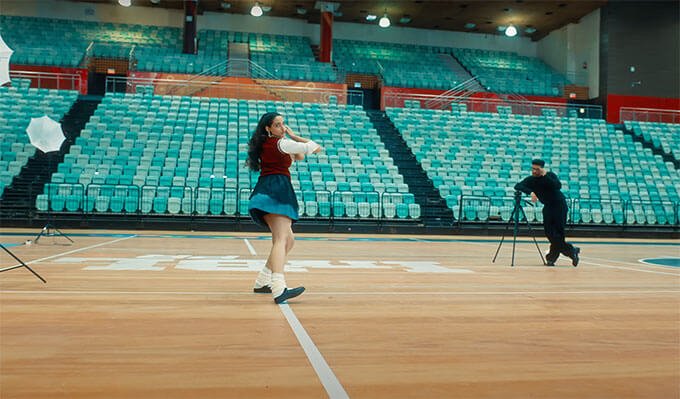
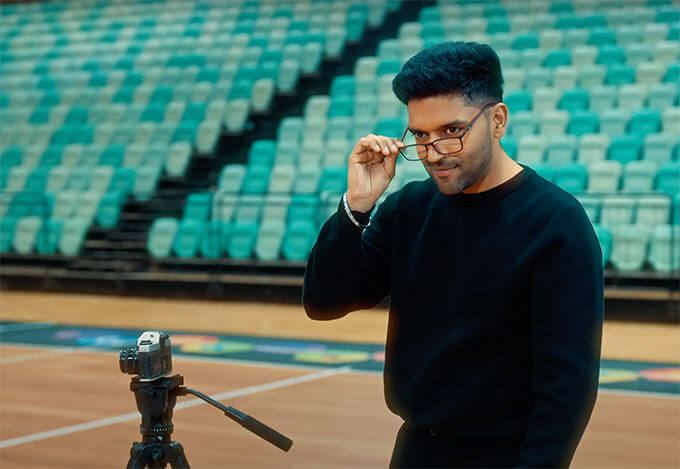
Let’s look at the Azul video again from these perspectives. It starts with a ‘Warning’, saying “This video is highly addictive”. The camera zooms onto a group of school girls in short skirted uniforms sitting in a stadium where a photographer (Guru Randhawa) trains his camera on them. The wider camera through which our gaze is invited zeroes in on one girl who blows a bubble gum till it bursts before she starts expressing her body and face suggestively as do her companions. One girl from the group walks out, as if on a ramp, carrying a lollipop (for god’s sake) which she chucks and walks on even as the “Guru” takes his spectacles off, hinting at arousal.
The Reality
Studies on the prevalence of CSA (child sexual abuse) in India, including one done in collaboration between the Ministry of Women and Child Development with UNICEF and the NGO Prayas, place it at 18-50 per cent dependent on the population studied. Another, done in 2022, which studied abuse reported by Indian college students, found that out of the 380 women and 194 men who consented to participate, 218 and 65 respectively, said that they had been sexually abused in the past. Sexual violence commonly occurred at 12–14 years but about 53 per cent of victims were under 12 years of age. The perpetrator was usually male (93.2 per cent), less than 30 years of age (54 per cent) and a stranger (42.7 per cent).
The way it attempts to normalise school girl fantasy as an imaginative piece of pop music risks imitations.
What About Product Pornography?
If the Azul video has incited rage, it is also an opportunity to examine what’s celebrated as the larger-than-life image of the Punjabi pop musician, rapper, singer, songwriter. The “man” who has transitioned from a farmer’s economy in Punjab to a global life of success, big cars and “Caneda-Amreeka” realisations. This masculinity (female Punjabi singers do not fall into this terrible cliché), is magnified by large pendants, chunky gold chains, rings the size of cookies, sneakers screaming in colours and large logos, brands, cars, bags and coats being invoked as crass announcements of romance and status. Where girlfriends are likened to monuments or acquisitions. These pop artistes dance on Burj Khalifa or around the Big Ben in London. For whom, the tractor from a farm in their pind (village) is as lovely as a girl, who is also called Lovely. In that desperate blend, where products and human beings are equalised as stuff of life, Guru Randhawa has added premium alcohol. Why are we surprised.
Yet, given the suggestive visuals of some sections of Azul, it must also be asked why the parents and guardians of girls we see dancing in the video being likened to tequila and whiskey did not question the concept enough?