Fraze Tasnim, who presented Dastkar at India Couture Week in Delhi on Friday, is leading the House of Rohit Bal through Indian fashion’s least tried challenge: succession
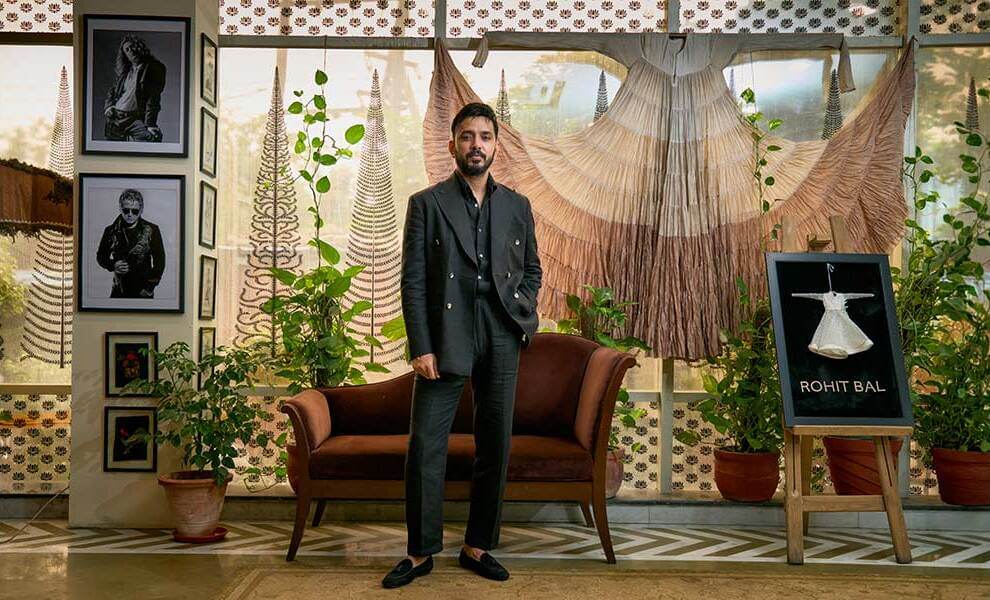
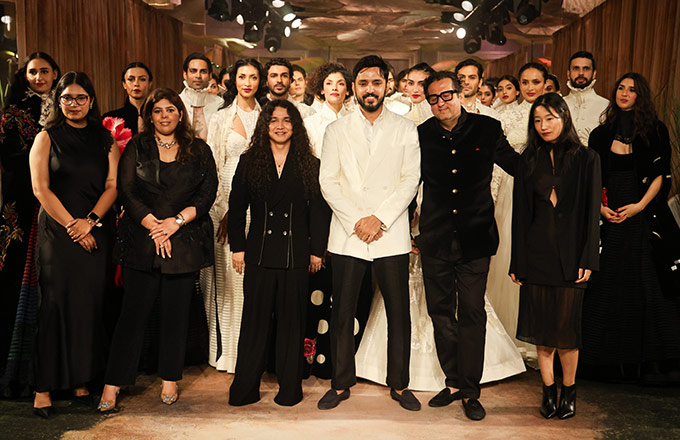
Last evening, Fraze Tasnim, creative director of the House of Rohit Bal, presented Dastkar at Hyundai India Couture Week at Delhi’s Taj Palace Hotel, in association with FDCI. A month earlier, when we met at the brand’s Noida atelier, our conversation was less about silhouettes than succession. At 39, Tasnim is not simply designing couture. He finds himself directing one of Indian fashion’s most emotionally charged creative legacies.
Rohit Bal was no ordinary name after all.
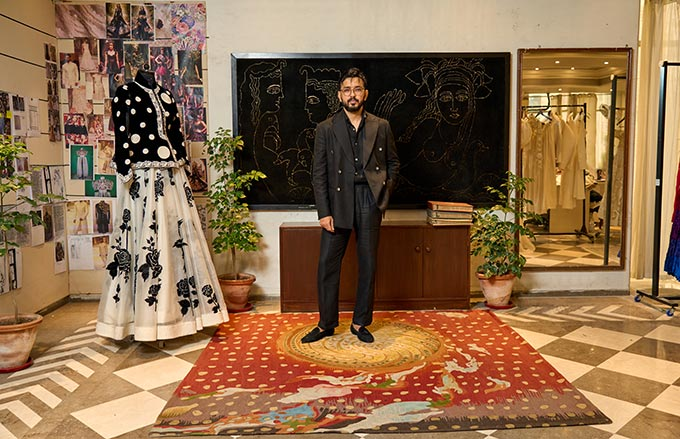
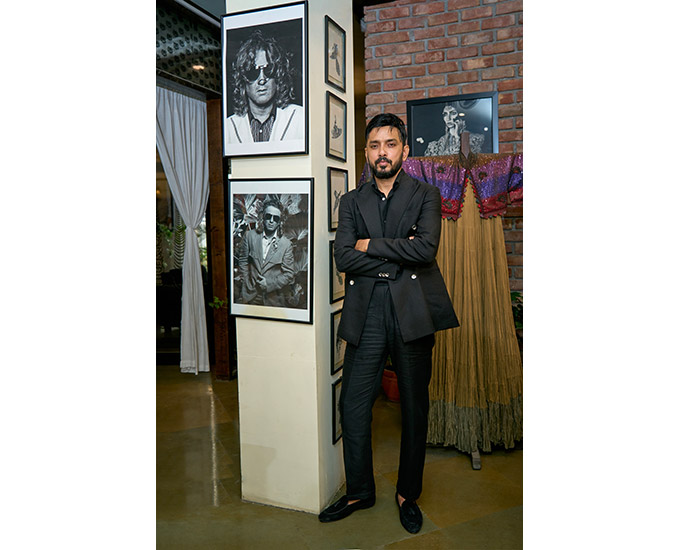
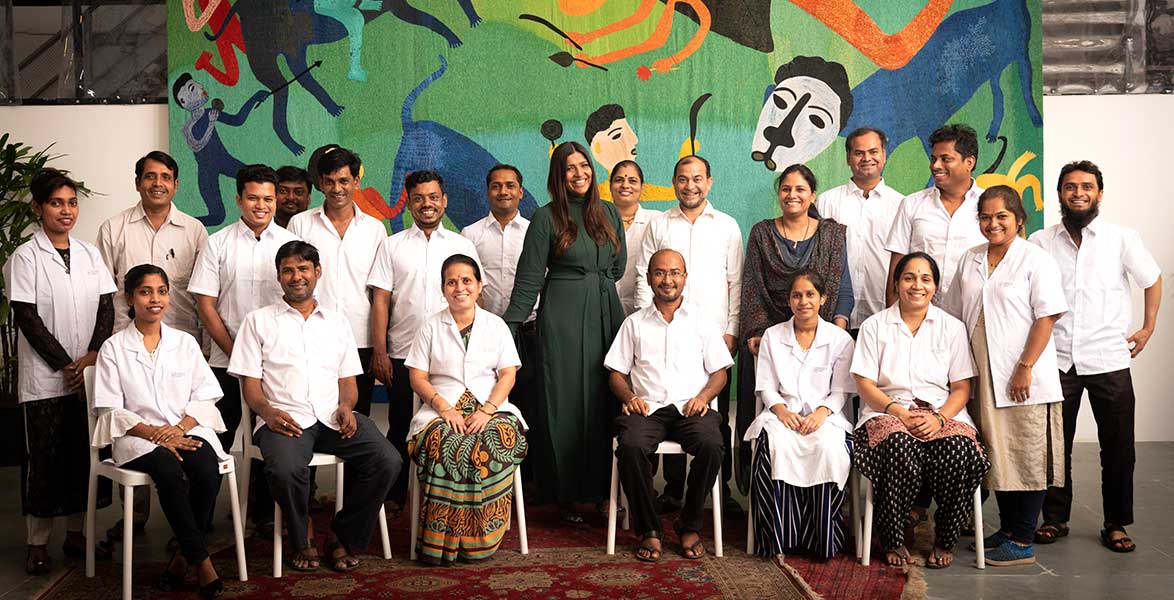
His Noida atelier still feels more like a living archive and less like a workplace. Photographs of Gudda—as Bal was affectionately known—most chosen carefully to express his flamboyant, devil-may-care self, watch over the studio. A majority of the workers here, including the receptionist, embroiderers, and craftsmen have spent nearly three decades with the label. A larger-than-life size photograph of Arjun Rampal, Gudda’s beloved friend, model and showstopper, sits on the wall. Glamour is not the first word that strikes you. It is nostalgia.
All kinds of teams continue their work with familiarity dyed in loyalty. A longing even, a missing, that leads to an instinct that Gudda is resting somewhere around. Everyone speaks fondly, even protectively of a founder who stood by them through difficult years, including the pandemic, and whose generosity has become part of the company’s institutional DNA.
Day 2 of Hyundai India Couture Week 2026 — Rohit Bal’s legacy carried forward.
In this world also lives Tasnim who joined Rohit Bal as a young designer, left briefly to complete an MBA at IIM Ahmedabad, and returned at Bal’s invitation. “Rohit sir said he needed me and asked me to come back,” says Tasnim, tears held back, their tide visible through his restraint. Tasnim is a restrained gentleman. Mild-mannered, impeccably turned out, soft-spoken. With spectacles, that he dons as he leans over the cutting tables, patterns of Dastkar spread before him, he looks like wisdom found a young accomplice.
Yet, while fashion is adept at celebrating beginnings and new collections, it is far less practised at confronting succession. Indian fashion, in particular, has been built around charismatic founders whose identities have become inseparable from the labels they created. Rarely has the industry been forced to ask what happens when an auteur is gone but the house remains. Today, Tasnim occupies one of the most delicate positions.
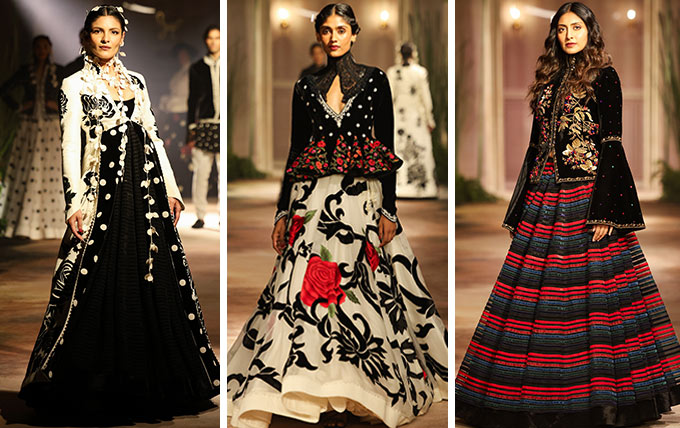
His collections since Bal’s passing reveal stewardship more than reinvention. He speaks of introducing checks, plaids, enlarged polka dots and new graphic rhythms into the vocabulary of the house. On the runway, however, those interventions appear only softly rather than decisive departures. The eye returns to the enduring signatures of Bal—velvet and ivory, florals and wildlife, theatrical silhouettes, ombré drapes, crinkled long dresses, sumptuous textiles and embroidery where couture feels spectacular.Previous
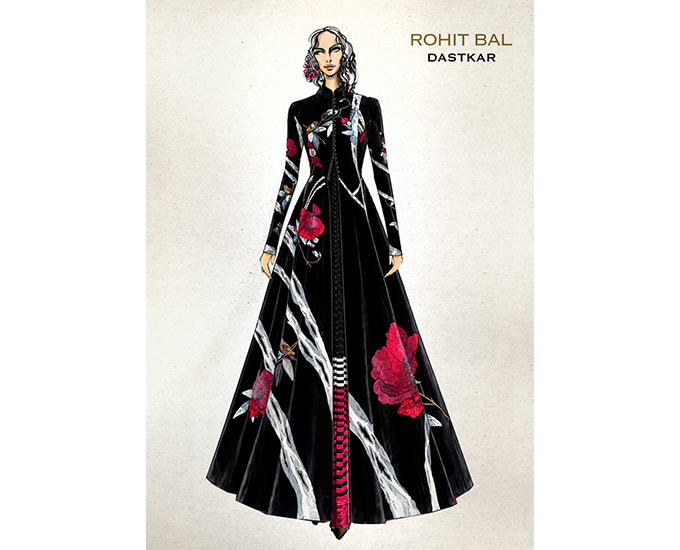
A work-in-progress silhouette from the collection.
Dastkar at India Couture Week steeped in Bal’s signature language of velvet, ivory, florals, and theatrical embroidery.
Tasnim is clearly not trying to step out of Gudda’s shadow. Oddly enough, you can’t even see the young creative director’s photograph in the line-up of couturiers at India Couture Week. The face used to represent the house is still of its late master. “It is because of emotion, the people here feel attached to Rohit Sir,” says Tasnim, hesitant to even grapple with the question.
And yet, he is all hands on the deck to give the House of Rohit Bal a future. International orders intact, consumer loyalty alive, a new store in Delhi’s Ambavatta is around the corner, he says. Standalone stores with Balance by Rohit Bal, the house’s prêt line will be opened in the coming months.
Whether this transition ultimately succeeds remains to be seen. But the House of Rohit Bal is attempting something Indian fashion has not yet rehearsed. By choosing continuity over rupture, Tasnim is testing whether a designer’s legacy can become an institution rather than remain a personality cult. If it succeeds, it may offer Indian fashion its first convincing blueprint for succession.
Fraze Tasnim, creative director of the House of Rohit Bal.
Edited excerpts from an interview with Tasnim, that took place last month. – Rishabh Batra
Rohit Bal’s work has always carried a distinct visual language—florals, architectural silhouettes, Kashmiri references… What do you believe are the non-negotiable codes of the house, and where do you think those codes still have room to evolve?
The identity of Rohit Bal has never been defined by motifs alone. Florals, Kashmiri influences and a sense of theatre are expressions of something deeper. It lives in the exceptional craftsmanship, emotion, artistry and timelessness.
These are the codes that should remain untouched. The opportunity to evolve lies is how those values are interpreted with fresh perspective through new techniques or ways of storytelling while remaining unmistakably Rohit Bal.
Creative directors who inherit iconic houses often have to resist two opposite temptations—to imitate and to strongly fork their own path. How do you know when you’re making a Rohit Bal decision, and when you’re making a Fraze Tasnim decision?
A legacy is not something you inherit; it’s something you honour every day. There has never been a line between a Rohit Bal decision and a Fraze Tasnim decision. The decision is always for Rohit Bal Design. (Working) 13 years with Rohit sir shaped not only the way I design, but the way I understand craftsmanship, beauty and emotion. Stepping into this role is both a privilege and a responsibility. My purpose is to honour the legacy he built while allowing it to evolve with sincerity and care.
At the same time, I believe a creative director must bring his own perspective. Otherwise, we would simply repeat what has already been done. My thought process will naturally become part of the work, but it will always remain aligned with the ideology and philosophy of Rohit Bal. My role is not to change the identity of the house, but to help it evolve while staying true to its essence.
Tasnim at his Noida atelier, in the quiet company of photographs of the late Rohit Bahl.
As consumer behaviour changes across generations, how do you see these different verticals strengthening one another? Is your ambition to build a larger fashion business, or to deepen the identity of the house across categories?
For me, a stronger business always begins with a stronger identity. Rohit Bal has a legacy of over 35 years, and that is our biggest strength. My role is to build on that foundation while staying true to what the house has always stood for.
In India, weddings and celebrations will always remain an important part of the luxury fashion business, and they are an important part of ours too. At the same time, our prêt line Balance, along with our accessories, helps us reach a wider audience while carrying the same identity, craftsmanship and values that define Rohit Bal.
My ambition isn’t simply to make Rohit Bal bigger. It’s to make the house stronger, so that whether someone experiences the house through couture, Balance or accessories, they instantly recognise the same Rohit Bal.
Few Indian designers understood the power of fashion as theatre the way Rohit Bal did. As audiences increasingly consume fashion through a phone screen, how do you think about creating that anticipation and wonder today? Do you also have glamorous showstoppers?
Personally, I think a showstopper has two meanings. The first is someone who genuinely belongs to the story of the house. For our first show after Rohit sir’s passing, actor and former model Arjun Rampal walked for us. Before he became an actor, he was a model and had a long association with Rohit Bal. His presence had meaning beyond celebrity.
The second is understanding that, as the person leading the house, I have to balance creativity with what is right for the brand. There are times when you also have to think about what helps the house grow and reach more people.
So yes, I believe in showstoppers. But they should never be there just for glamour. They should have a genuine connection to the house, and the choice should always feel authentic and serve the story we’re telling.
Shefalee Vasudev is a journalist, cultural commentator and editor-in-chief of The Voice of Fashion, a digital magazine on fashion, culture and design. Author of Powder Room: The Untold Story of Indian Fashion, Shefalee worked at India Today, The Indian Express, and Mint Lounge, in senior editorial roles. The first editor of Marie Claire India, she is now a trained narrative therapist.

 The Voice of Fashion