The Voice of Fashion
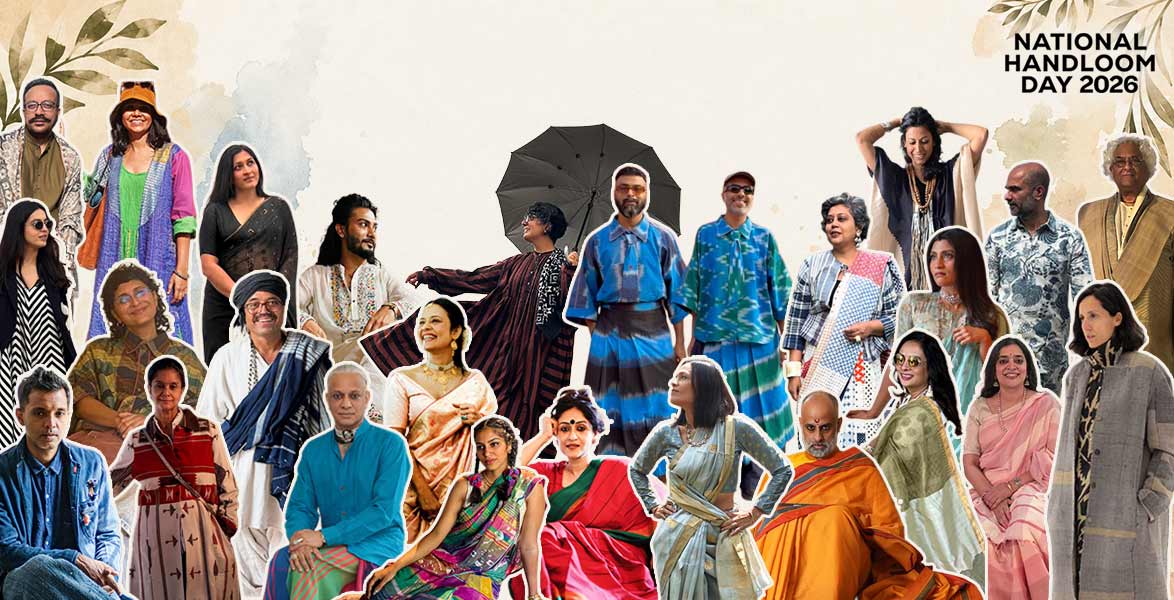
Our pick of distinctive dressers who make the case for skill, style and substance. Celebrating ‘The Act of Wearing Well’.
At The Voice of Fashion, National Handloom Day is worth marking every year. More so, certainly, than the manufactured calendar of Mother’s Day, Father’s Day, Friendship Day and the rest. August 7 has also acquired its share of ceremony, commerce, platitudes and promotion. Yet every year, it gathers something important: India’s astonishing and still evolving relationship with cloth.
Across the country, Handloom Day now stretches from artisans, karigars and weaving communities to museums, material researchers, designers, institutions and markets. There are exhibitions and awards, new experiments and old arguments, sales pitches and government pronouncements. This year, the initiatives that caught our attention went into the bulletin we published yesterday. Among them is the Material Library of India’s work around regenerative fibres, which can be viewed from August 13 at Handloom Haat in New Delhi. Not everything deserves equal applause. But the collective attention does.
For me, handloom is also intensely personal. I singularly prefer woven saris. They speak to me about where I come from but, curiously, they keep revealing something about who I am now. My saris are part of my interiority and inspiration: reminders of identity, of the material intelligence of who weaves what, how and why—and, eventually, of why something matters to me.
Perhaps that’s why dancer and poet Tishani Doshi’s words stayed with me. She sent these when asked to tell us about the sari she wears in the photograph you see of her on this list. Writing about her relationship with textiles, she says: “Perhaps it begins with my Kutch roots, but I get a real sense of wonder at seeing what people have done with thread and dye for centuries.” And then, a line I especially like: “My wardrobe is really a map of the places I’ve travelled.”
A wardrobe can indeed be a map. Of geography, inheritance, politics, pleasure—and taste. Mine is also something of an “old curiosity shop”. I stash perfumes, saffron face masks, fresh flower petals, old crochet placemats that I inherited from my nani and mother (who handmade them) among my clothes. Scents and memories rise alike from them adding those fleeting “who I am at the moment” feelings.
“My saris are part of my interiority and inspiration: reminders of identity, of the material intelligence of who weaves what, how and why—and, eventually, of why something matters to me.”
Our Handloom Style List 2026 looks at one particular corner of this enormous landscape: people who wear handloom exceptionally well. This is not an exhaustive list, but it is representative of a strong, thriving argument. It is not necessarily easy to wear handloom stylishly. Woven garments can become reverential, overly styled, predictably “ethnic”, or burdened by the responsibility of announcing heritage. The most interesting dressers escape all of that. They make the cloth their own.
The people on our list come from different worlds—arts and crafts, cinema and design, dance and literature, cultural practice and the loom itself. Some are flamboyant, others austere. Some collect and conserve; others disrupt and reinvent. Men and women, each stands out not principally for the clothes they wear, or how they wear them, but for something else that defines them. What connects them is not a single aesthetic, but the ability to wear handloom with conviction and individuality.
So, this National Handloom Day, we celebrate another form of advocacy: the act of wearing well.
It is a homage to skill, style and substance.