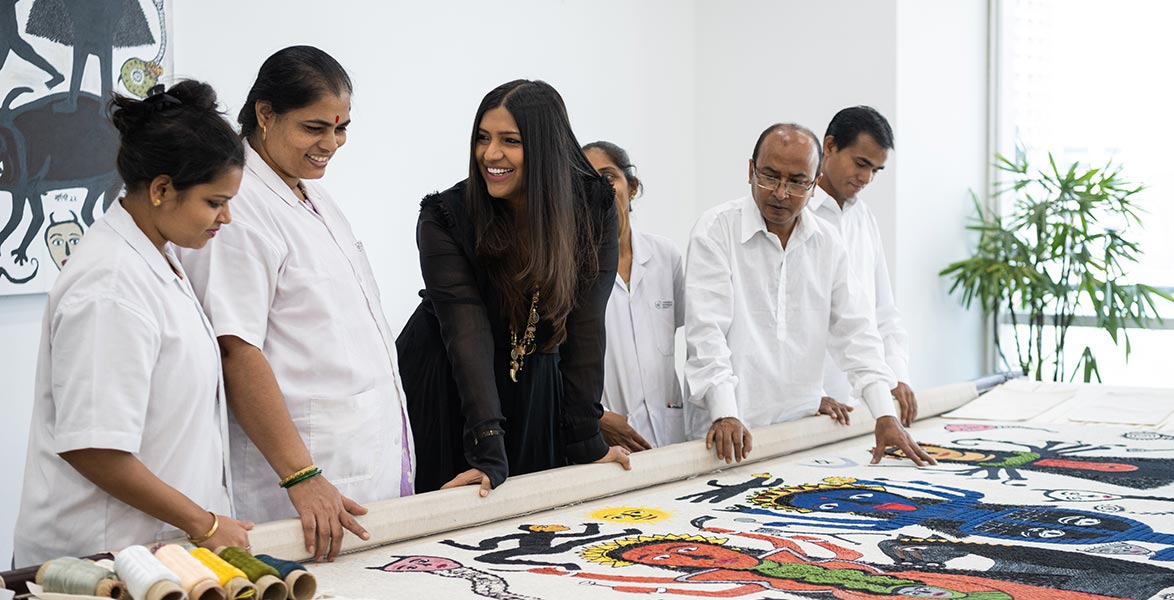
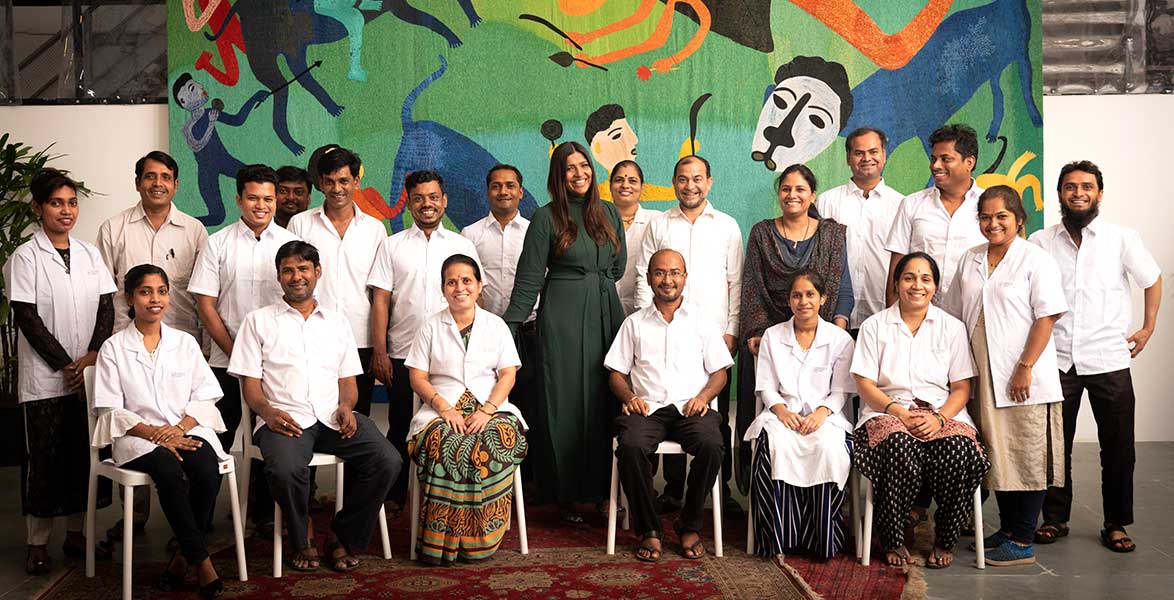
As Chanakya, the atelier, marks 40 years with three ongoing exhibitions in Mumbai, it is time to examine the expanding art-and-craft practice of its director Karishma Swali as an artist and institution-builder in her own right
The day after celebrations marking 40 years of Chanakya opened in Mumbai last week, Priyanka and Prateek Raja, co-founders of Experimenter, spoke about the beauty of persistent practice in craft. The gallery takes a multidisciplinary approach; it is an incubation space for contemporary ideas and practices, even as the visual, sonic and sculptural arts accelerate communication with its audiences. It is at their space in Colaba that Belong, one of the three ongoing exhibitions by Chanakya, is on display. This is the second artistic collaboration between Experimenter and Chanakya (the first was in Kolkata), and the word “belong” resonates in what you see. “Belonging extends beyond location to encompass what one carries: histories held in fibre, gestures transmitted through the hand and forms of knowledge renewed through making,” says the exhibition note.
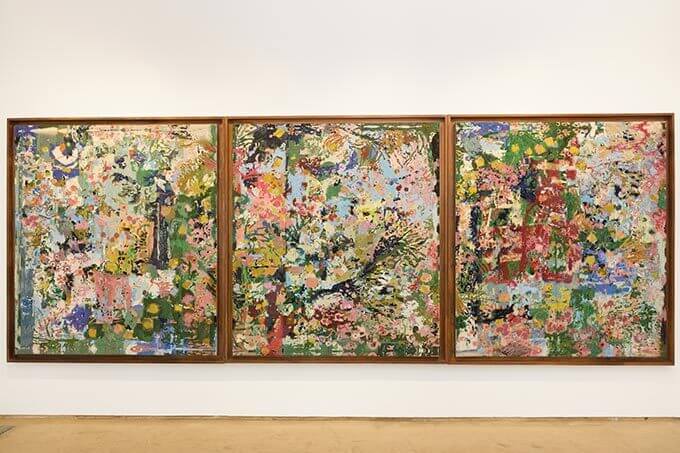
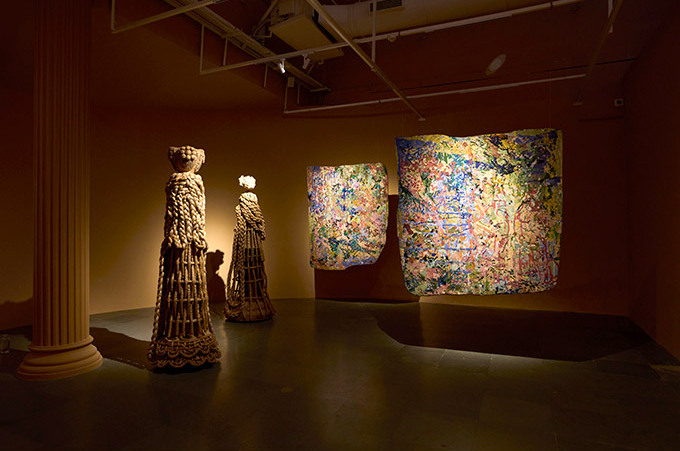
There may be less erudite ways of taking in all that you witness. In the small textile and embroidery pieces plucked out from the processes of creation at Chanakya, framed in their own right, this writer finds an organ-like presence, literally from the bodies of the large artworks. An ascending musical alaap through thread placements in one; in another, a piece of textile in the shape of the heart, the beating muscle in the body. There are huge, wall-sized artworks—worlds within worlds—made with threads, yarn, cord, mohair, jute, glass beads, cotton and silk.
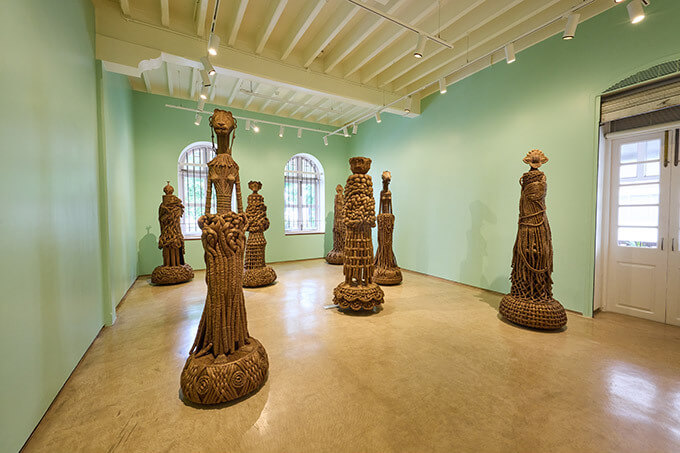
‘Belong’ presented at Experimenter – Colaba, Mumbai.
Elsewhere, there are tall sculptural female forms made from coconut, jute and banana fibres. They have been braided, coiled, bound and woven. On the walls, the names of every and many artisans who created these pieces are written, led by that of Karishma Swali. The creative director of Chanakya International and Chanakya School of Craft, she is also the founder and chair of the Chanakya Foundation. A steadfast believer in shared, collective credit, her work, as Priyanka says, is “dialogical”.
The Never-Ending Dialogues
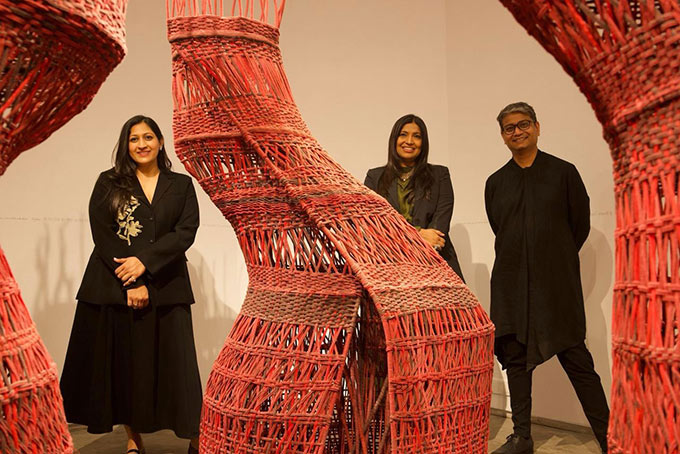
Priyanka refers to another work, titled Dwelling, by Karishma and the Chanakya team for Trace—an exhibition held earlier this year at Experimenter’s space in Kolkata. A hand-sculpted armature wrapped with cotton thread, Dwelling is a triptych in dialogue. Here are some excerpts.
“I listen to my hands.”
“Fractures are part of form.”
“Every mistake teaches the hand something new.”
(L-R) Priyanka Raja, Karishma Swali and Prateek Raja.
So, when Priyanka says she sees the Chanakya artist collective as conceptually vigorous, technically advanced and globally relevant, and that the dialogues around women, the body and home give it a linear voice, she also lends words to understanding Swali the artist. Swali’s acumen as an artist has been publicly seen and applauded only in the last two editions of India Art Fair and at Trace, which makes the recognition seem recent. But her practice is a three-decade-long juggernaut.
She credits her father, Vinod Shah—who launched Chanakya International as a textile and embroidery house 40 years ago—as her forever inspiration. Yet it would be simplistic to see Swali purely through the prism of what she and her brother Nehal Shah inherited. Similarly, broadening her practice to what she makes as a fashion designer for Chorus, her bespoke and prêt-à-porter fashion-art store in Mumbai’s Kala Ghoda; at Jade with her sister-in-law Monica Shah; or through her many internationally acknowledged collaborations with the well-known Italian designer Maria Grazia Chiuri, would be tying fat knots in the story without first disentangling the threads.
‘Belong’ presented at Experimenter – Colaba, Mumbai.
Bigger Than Just a Brand
“For over 40 years, a quiet revolution has been unfolding in the heart of India’s heritage. Step by deliberate step, Chanakya has built something far greater than a brand; it has sculpted a lasting legacy rooted in dedication, masterful strategy, and a matchless knowledge bank. At its core, it is an emotional pact with the human hand. It breathes life into the dignity of labour, proving that true luxury is born from the patient, rhythmic work of master artisans,” says Darshan Shah, the founder of Weaver’s Studio, Kolkata.
Shah adds that through painstaking collections of archival material, Chanakya has preserved the ancestral whispers of design, transforming raw skill into a living culture.
Is that where Chanakya’s ‘Arthashastra’ begins to assert its heft? An art-craft-creator-collaborator-commercial matrix. “Through a marriage of skill development and education, it has uplifted countless craftspeople, wrapping structural empowerment in deep empathy and sensitivity. Today, the very strategy and artistry nurtured in these workshops stand as the backbone for some of the world’s most prestigious fashion labels across Europe and the US,” says Shah.
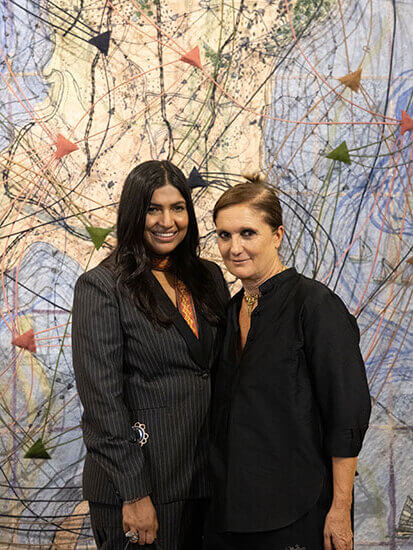
Karishma Swali and Maria Grazia Chiuri.
Swali elevates this ‘Arthashastra’ beyond a successful design and embroidery supplier business. She brings her core underpinnings to it. She listened clearly to what the archives whispered to her. Then took heritage, craft, hand-skills, fractures, movements, mistakes and her own reverberating feminist stance and added them to the commercial strong pillars of Chanakya. A Foundation and a School, too.
“My practice began long before I had a language for it. As a child, I was constantly drawing, looking at art and antiquities, and fascinated by the histories held within objects. Working alongside my father and our master artisans gave me an intimacy with material and making, while my time in Italy (where she studied and worked) opened another way of looking at art, design and cultural histories,” says Swali. She says this in response to a question about her practice as distinct from her father’s business and her long artistic association with Maria Grazia.
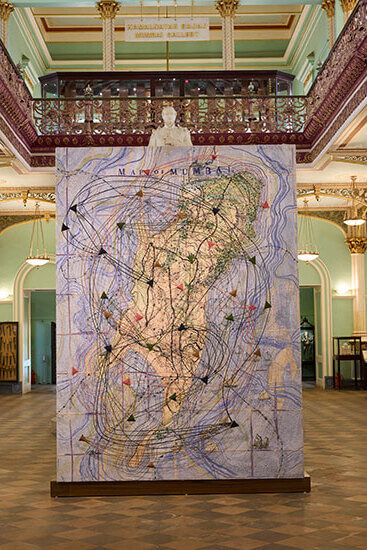
Installation view of Island presented at En Route, Dr. Bhau Daji Lad Museum, Mumbai.
Installation view of Island presented at En Route, Dr. Bhau Daji Lad Museum, Mumbai.
Ryan Martis
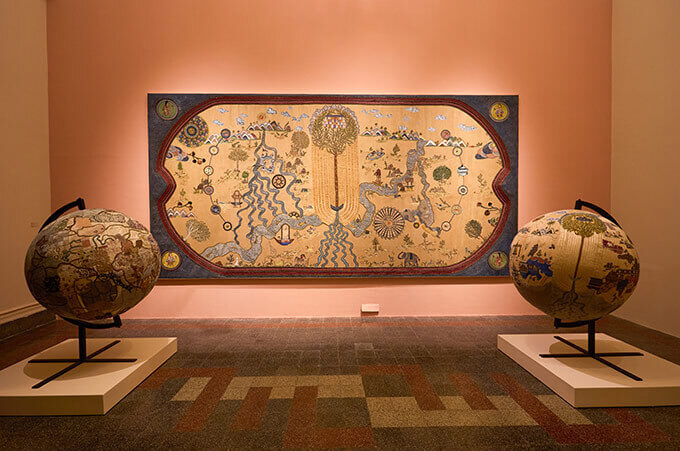
Installation view of Antrik Vishva I, Antrik Vishva II & Vasudhaiva Kutumbakam presented at En Route, Dr. Bhau Daji Lad Museum, Mumbai.
En Route: From the Vatican to Mumbai
This is perhaps the right turn in the story to arrive at En Route, currently on view at Mumbai’s Dr Bhau Daji Lad Museum. An artistic collaboration between Maria Grazia, Karishma and the Chanakya School, with curatorial advice from the museum director Tasneem Zakaria Mehta, the show explores concepts of mapping and discovery at the Vatican in Rome and Mumbai. The seven layers of cartographic drawings in thread recall Mumbai’s earliest avatar as Heptanesia—tracing the city’s growth through reclamation, trade, the cotton mills, sea trade and Art Deco. First shown at the Vatican Apostolic Library last year, where Maria Grazia and Karishma had been invited to create a body of work in dialogue with the existing collections, En Route began as a reflection on the works of six women writers.
“Over the years, such experiences have come together in a practice that draws from the past while instinctively following my own vocabulary visually. The School, the atelier and my creative dialogue with Maria Grazia are all part of that continuum. At the centre remains my curiosity about material, the feminine, nature and the histories we carry forward,” says Karishma.
Installation view of Tapovan – Ika, Dwi, Forest I & II at Garden of Gestures presented by Chanakya School.
Forest, Grove, Hermitage
Instinctive is perhaps the most authentic route for creators of all persuasions. Instinct helps map one’s dreams and core beliefs—or un-beliefs—with what is created. The Garden of Gestures, the third exhibition celebrating Chanakya’s 40th year—besides the red-carpet appearances, parties and lavish meals over two days—gives language to this interiority. “Exploring Languages, Histories and Futures of Making,” the show works around the structures of forests and groves through the philosophical cadence of Upvan (garden), Tapovan (an ascetic forest) and Kunj (a bower).
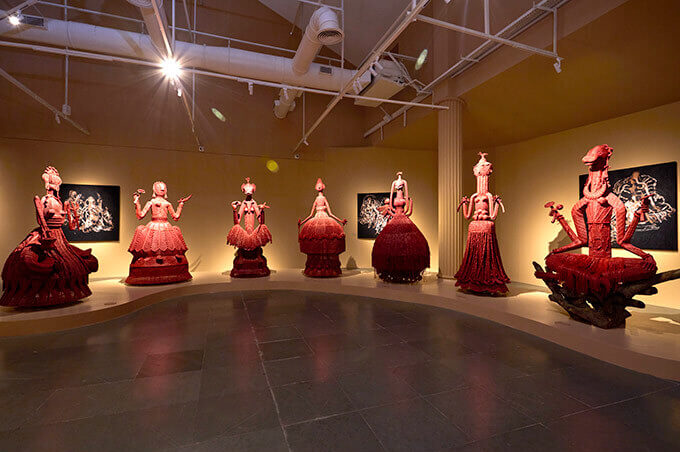
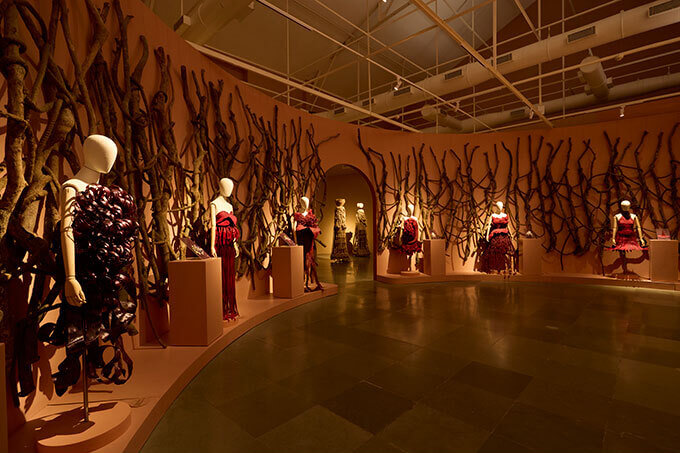
Tools of making, visceral swatches from textiles, dresses that appear more embodied and meditative than fashionised and again, as in Belong at Experimenter, and the Saptamatrikas or Seven Mothers, emanate as large-scale sculptural forms. They symbolise seven values and are made from bamboo, cotton and raffia; they show techniques of basketry, weaving, knotting, plaiting, coiling and herringbone structures. The lights are dim, the manjistha-red textural intensity of the sculptural forms adds drama. Chanakya’s other artworks, now familiar—large forests x grove x hermitage x bower x arbour forms—are framed large and wide. In them reside Swali’s vivid colour universe, a striking view into who she is. Optimistic, smiling, distanced. The reds run deep, the blues are blatant, the greens beckon, the turmeric is restorative.
Installation view of Tapovan – Saptamatrikas at Garden of Gestures presented by Chanakya School.
Installation view of Upvan at Garden of Gestures presented by Chanakya School.
“I am fascinated by the alchemy of nature’s palette: lac, indigo, manjistha, pomegranate rind, myrobalan, turmeric, marigold, iron, barks and leaves. Craft has always drawn from the natural world, from the fibres and pigments we work with to the colours they yield. I find the unpredictability of natural dyes beautiful; they shift with material, time, and process, giving every colour a depth and singularity of its own,” she says.
Every artist too, drawing from that analogy, would have a depth and singularity of their own. If one had to choose a defining personality colour for Swali, it would be iron. Not only because she mostly wears shades of black, but because iron is tensile. It is capable of holding both impact and movement. Chanakya’s ‘Arthashashtra’ that encompasses the atelier, the Craft School, the Foundation, the artisans, the commercial enterprise and Swali’s artistic practice has an iron will.
Shefalee Vasudev is a journalist, cultural commentator and editor-in-chief of The Voice of Fashion, a digital magazine on fashion, culture and design. Author of Powder Room: The Untold Story of Indian Fashion, Shefalee worked at India Today, The Indian Express, and Mint Lounge, in senior editorial roles. The first editor of Marie Claire India, she is now a trained narrative therapist.

 The Voice of Fashion