The Voice of Fashion
Kalaa the store tells the story of the sari even as the sari tells the story of Kalaa. What, then, is the real story—the sari, the store, or something entirely unexpected?
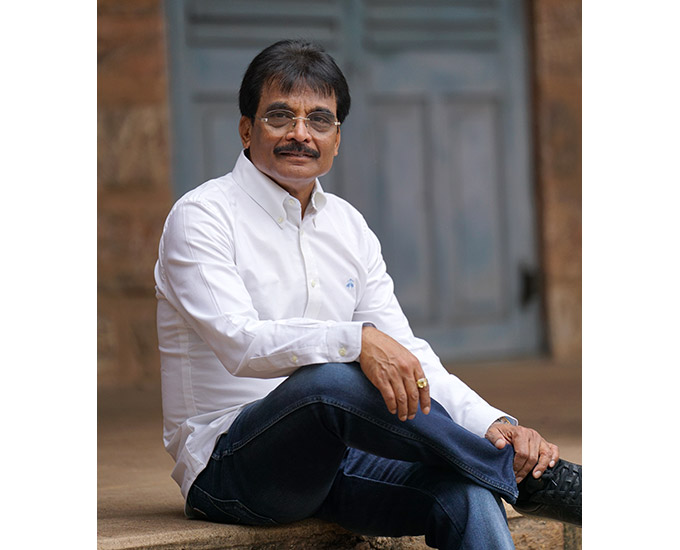
The last page of a tall, slim catalogue printed on finely textured paper carries a photograph of Mallik Kankatala and his son Anirudh standing at the Visakhapatnam seashore. The catalogue, a publication of Kalaa by Kankatala—a new sari store—leads with a cast of deep green-blue colours. Mallik, the father, also the chairman and MD of the sari business, has an arm casually thrown around Anirudh’s shoulder, the young director of this third-generation enterprise. Both observe the ebb and tide of the sea in awe. The father and son may have an eye on the future looming up in the tumultuous waves, or perhaps they are thinking about how the sea eventually washes everything ashore.
This particular catalogue—one among Kankatala’s several artistically published materials—narrates the story of Kanchipuram, the city of luminous weaves and a thousand temples. It is a travel guide which, curiously enough, ends with a poem by Akhila Pingali describing Vishakhapatnam as the City of Destiny. Why a full photographic story and travel guide on Kanchipuram should end with a poem about Visakhapatnam, you wonder. Answers dawn, but later.
Cataloguing The Experience
Kalaa, described as The Art of The Sari, is essentially a store of finely picked and deliberately woven saris. But to introduce itself as a shopping destination and a house which clearly wants to be seen as a tastemaker, it assimilates several sensory and material ideas. Two weeks back, guests from outside Visakhapatnam (including this writer)—invited to mark the opening of this new store—find themselves welcomed with a large box lined with fine textiles. Inside it is a unique 12-month calendar made from old textiles, re-cut to fit the vertical design; the dates printed on fine creamy cotton. There is Araku coffee, podis, dry chutney powders, and cards dense with information and drawings.
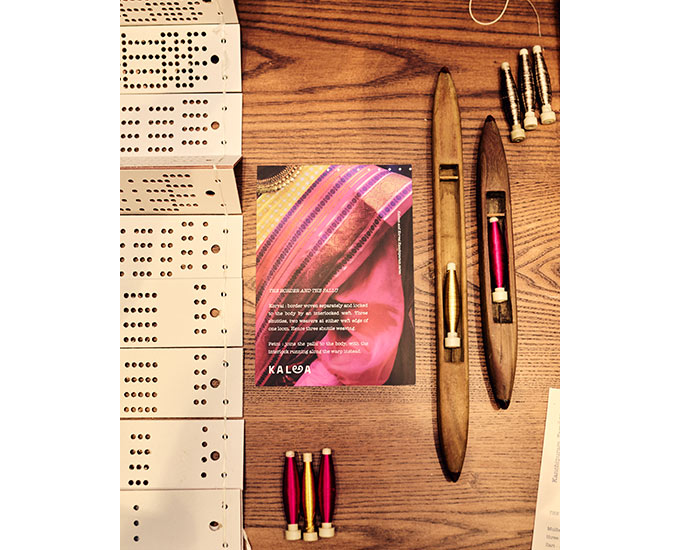
Over the day, a stack of beautifully designed cards packed in a recycled piece of Banarasi brocade tell you about motifs like Ganda Berunda (two-headed mythical bird), Maanga (mango) and Maan (deer), the weaving grammar of a Korvai sari, and why it needs two people on one loom at the same moment. There are tidbits on Mulberry silk; photographs of flowers rustling with silks, the Kolam motif of the Pochampalli, a hot chilli rasam recipe.
The Sensory Rush Around The Sari
The day had begun with a visit to the famous Simhachalam Temple. As rain lashed the stone carvings and lit up the surroundings, a sensory rush began to build. Baby cups of locally-brewed filter coffee added to the adrenaline.
All elements programmed by the Kankatala family were designed to pay homage to the cultural heritage of Andhra Pradesh—including a well-thought-out stay for guests at Pema, the luxury wellness resort. Anirudh, wearing a veshti and kurta with an angavastram, was joined by his wife Sonika and mother Silpa at the Narasimha temple. They held baskets stacked with cloth and fruit offerings. The ancient teal of the temple pillars, its textile-draped pundits, black and ivory stone carvings, idols nestled in unexpected enclaves, the flurry of faith, and the beats of devotional drums kept one engrossed.
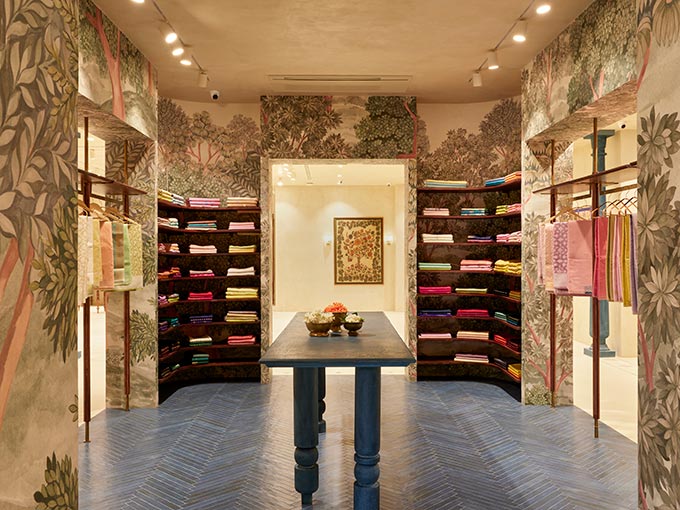
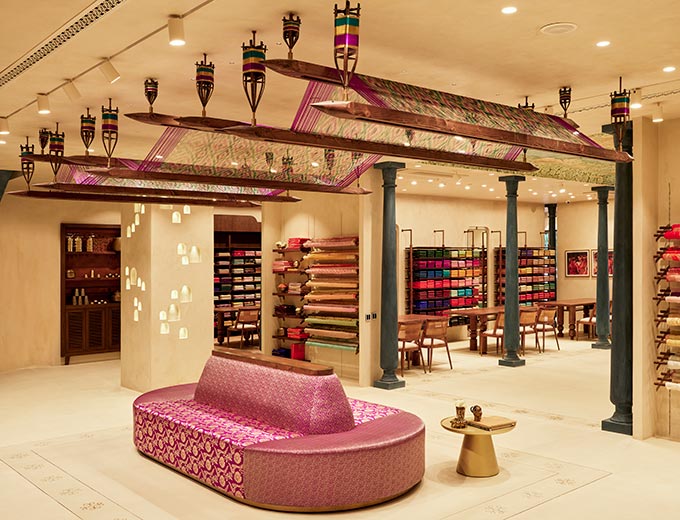
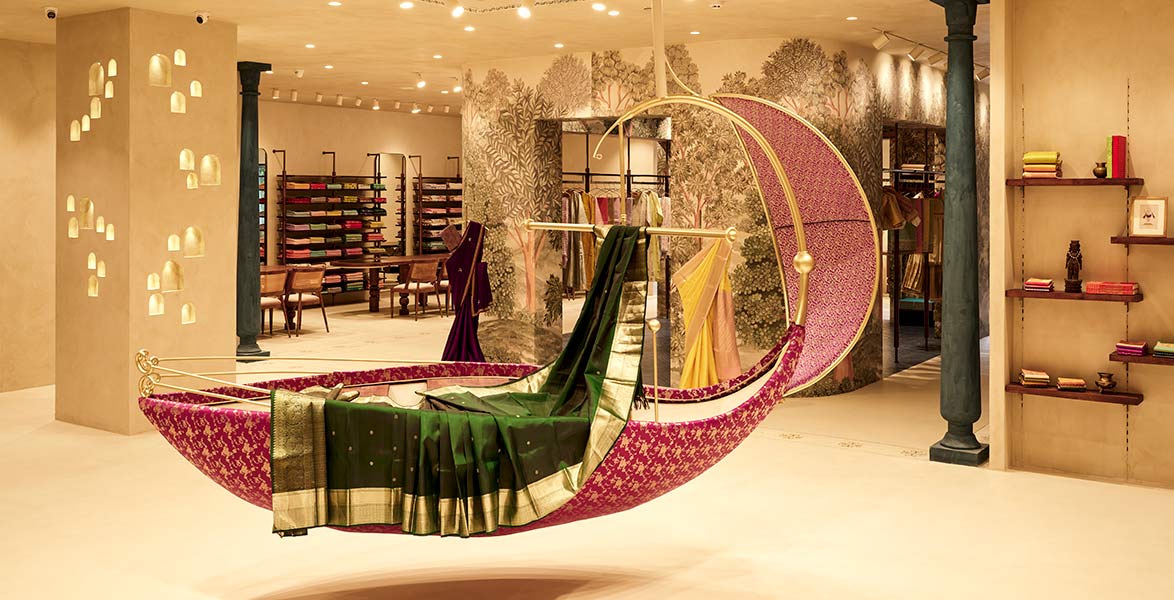
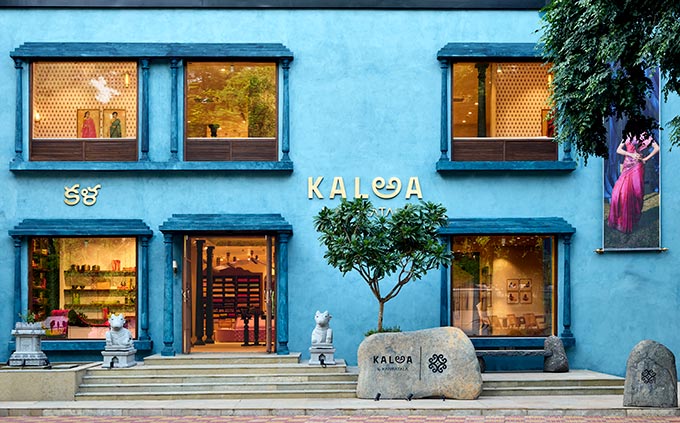
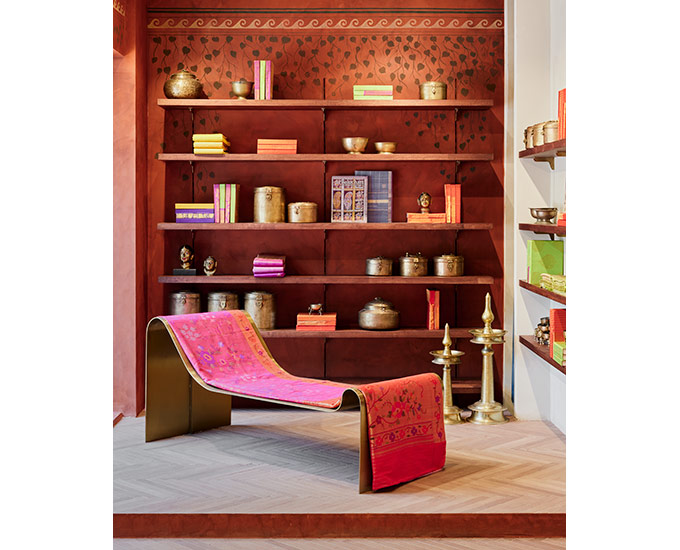
Over a full day and more, the Kankatala family rolled out the mind and matter of the sari. An ever-evolving narrative form, the sari can be spiritual, romantic, temperamental even as it is geographically diverse. Its tactility insistent and its textiles fascinating, it became the narrator of the 7,100-square-foot store built over two levels. Designed by experiential designer Devika Narain, it captures the essence of a traditional Andhra home with hand-painted walls, brass objects, framed textiles, an elevator with a brocade bench, blue staircases and a boat laden with silken saris.
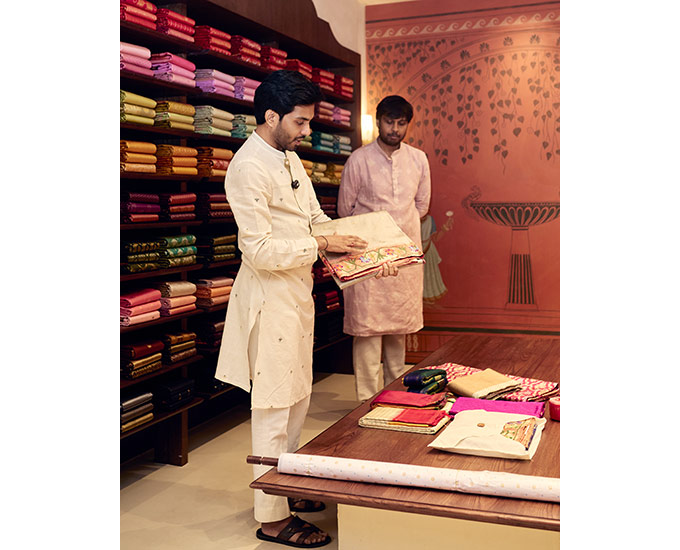
The store design and the programming showed guests how the Kankatalas—Generations Then and Now—treat the sari as a living system in Indian life. It was the saris themselves that had to retain their dominance—their patterns and particularity—above the sensory accumulation of lamp lighting, flowers and incense, hand-painted walls, Andhra delicacies and warm smiles. The juggernaut extended to short talks on Kalaa the store, with memoir-anecdotes from the family and from Narain. Then Anirudh spoke passionately and eruditely about how the sari behaves at rest (folded) and in motion (on the body), and the weave of the evening began to acquire a certain clarity.
Folding The Sari
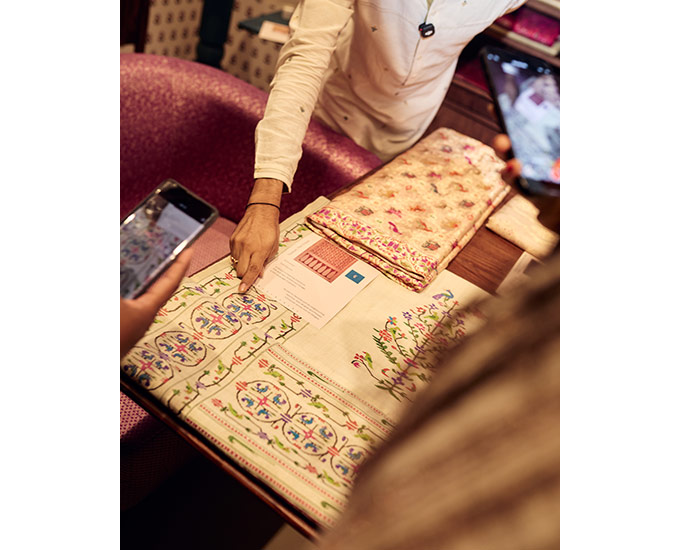
Different textile saris are folded in different ways, he explained—a Gadwal is rolled before being double folded into a slimmer than yoga-mat shape; a Banarasi on the other hand gets the wider space of a horizontal floor cushion. Kanjeevarams are folded to reveal their borders, pallus and the field, and their breadth (unlike most other silks, a Kanjeevaram is 48 inches wide). This itself was a standalone rendering—sari at rest and in motion—that could have held the launch within its single sharp focus.
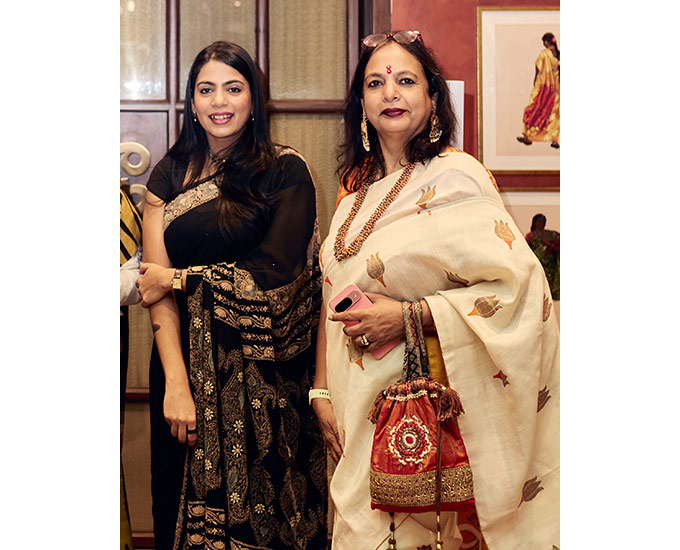
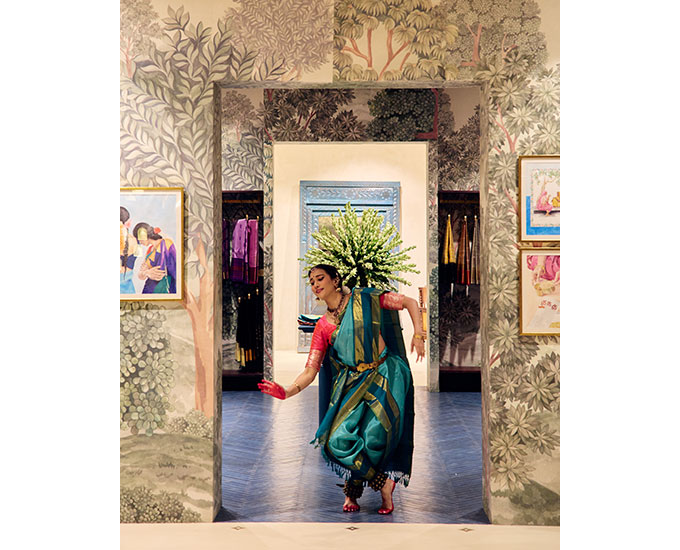
But the interpretations continued. A poignant Bharatanatyam performance by Delhi-based artiste Shreyasi Gopinath on the “Sari as An Emotion” was followed by a boisterously enjoyable, large meal with two dozen varieties of home-cooked Andhra dishes, served personally by the family. Men dressed in handloom kurta sets and women in handwoven saris that would need another story to describe.
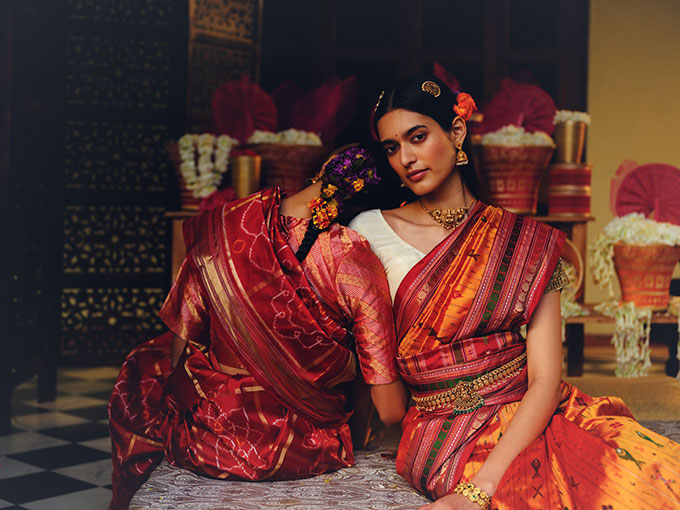
But where were Kalaa saris?
Everywhere, apparently. Folded into categories of colours and weaves, they are a universe by themselves. Banarasis to Kanjeevarams, Paithanis to Patan Patolas, Gadwals, Maheshwaris and Chanderis, Telia Rumaals, Ilkals, Pochampallis, Uppadas and Jamdanis. That hardly sums up the variety. Kanjeevarams are the uncontested heroes of Kalaa’s sari collection, which explains why the blue-green catalogue deserved a standalone publication. The weaving grammar of the Gadwals and the colour-blocking tells you that the selection understands the architecturally compelling weave. The Patan Patolas, especially the naturally dyed ones, in elegant, mellow hues, stand apart from what is often seen in Gujarat’s stunning double-ikat vocabulary.
The Complexity of Abundance
The experience was exceptionally well-produced, bringing heritage and futuristic curiosity into one frame. Yet Kalaa’s way of looking at the sari began to compete with the saris themselves. The food, flowers, temple colours, music, architecture, family histories, cards, recipes, weaving diagrams and stories of folding form an interpretive surround. They tell the customer how to look before asking her to buy.
And yet, abundance has its own risk. It can overwhelm the very thing it wants to illuminate. A sari is capable of carrying its own history. It does not always need a chorus around it.
Perhaps Kalaa’s real distinction lies in the insistence that a sari can be looked at slowly: its fold, its border, its width, its colour, its loom, its motif, its movement on the body. The store surrounds the sari with stories, but ultimately the drape itself will have to hold them. That is the test.
Banner: Boat Installation inside the Kalaa store.