The Voice of Fashion
On learning to spin, the limits of scholarship, and the unexplored possibilities of an embodied practice
A few weeks back, having finished researching and writing an extensive paper titled Reimagining The Charkha For The Modern World—work that had gone on for a couple of months—I felt I didn’t quite understand the value of embodiment that spinning held in its promise. Of course, I understood the theory: Gandhi’s views on the charkha for self-reliance, spirituality and concentration. Rabindranath Tagore’s rebuttal in The Cult of The Charkha, arguing that a repetitive activity prescribed as a path to freedom from colonial rule would undermine the agency of people of different temperaments and persuasions.
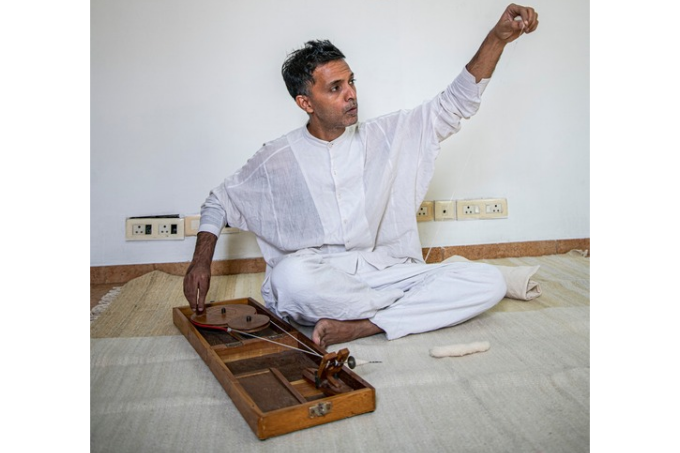
The shifting historical and contemporary inquiries around the value of spinning by historians and authors stayed in my interest long enough for me to realise that I must first learn to spin myself. On an indigenous, wooden charkha, seated on the ground. To observe and repeat the rhythmic activity as a prerequisite to developing any worthwhile scholarship.
One needs a guru whose body language at the charkha and attention one must observe. Whose teachings one must accept—from learning to twist the yarn to understanding the practice, without the burden of generating livelihood or producing a certain amount of Khadi yarn.
Beyond Khadi: As Insights Stack Up
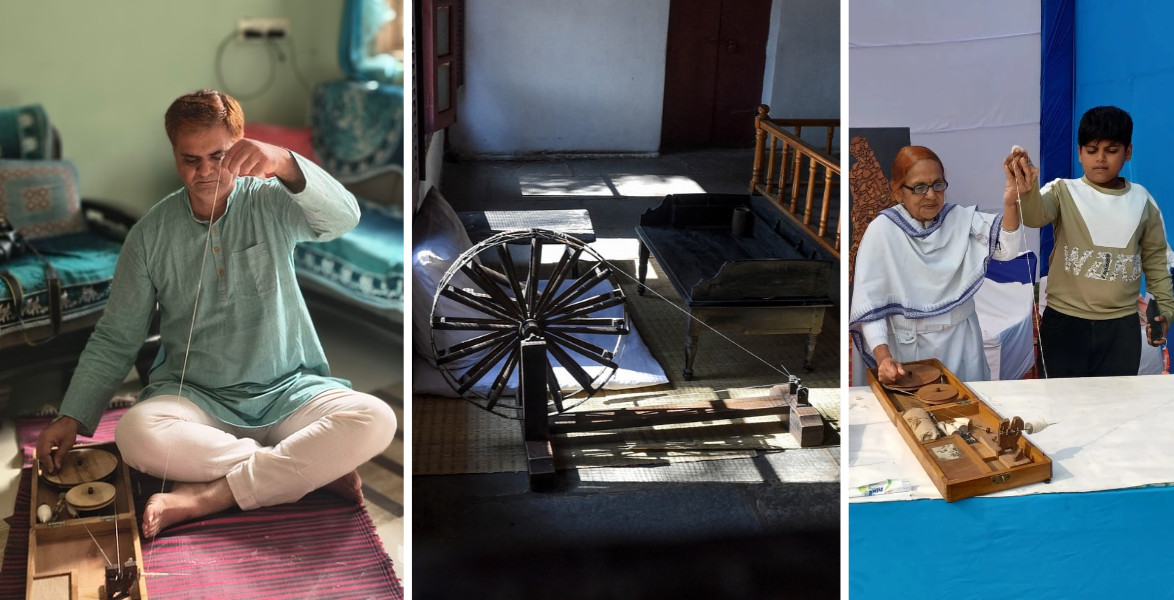
From Ghatit Laheru, the former head of the crafts development NGO Khamir in Kutch, who later, with the help of Khamir, started Kantai, a Kutch-headquartered platform that teaches, advocates and stands for the values of charkha spinning; to “Induben”, as the spinner is commonly known among Delhi’s Khadi circles. From designer Shani Himanshu of 11.1/eleven eleven, who can spin on the peti (box) charkha; to Nargis Zaidi, who teaches at the National Institute of Fashion Technology and is a part of the Centre of Excellence for Khadi—the insights have only been stacking up.
I sought some thoughts from Khadi historian and author Rta Kapur Chishti as well as from textile scholar and writer Rahul Jain. Design guru and scenographer Rajeev Sethi of the Asian Heritage Foundation pointed me to the takli—the simpler, smaller indigenous spinning tool that is often associated with contemplative practice.
Laheru told me about an intensive, collective yarn-spinning event scheduled this January at Bapu Kuti Complex at Sevagram in Wardha. To be led by senior Gandhian Madhav Sahasrabudhe of the Friends of Charkha group, this is for advanced learners only. I am not eligible, but it motivates me to practice as much as I can.
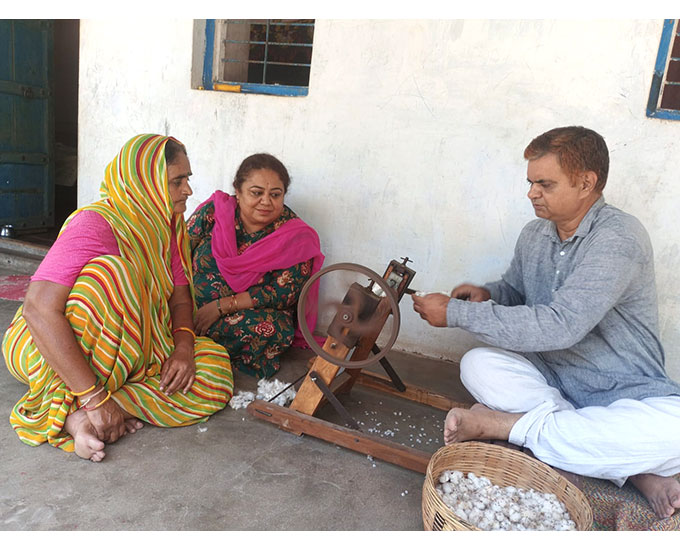
Laheru also enlightened me about a “charkha-based curriculum” in schools that has been introduced through Sugari Shala, an education initiative of Khamir. How to take spinning to society is his beautiful problem currently. He informed me that 120 women from different villages in Kutch use the peti charkha distributed free by Khamir, so that they could improve their lives and livelihood.
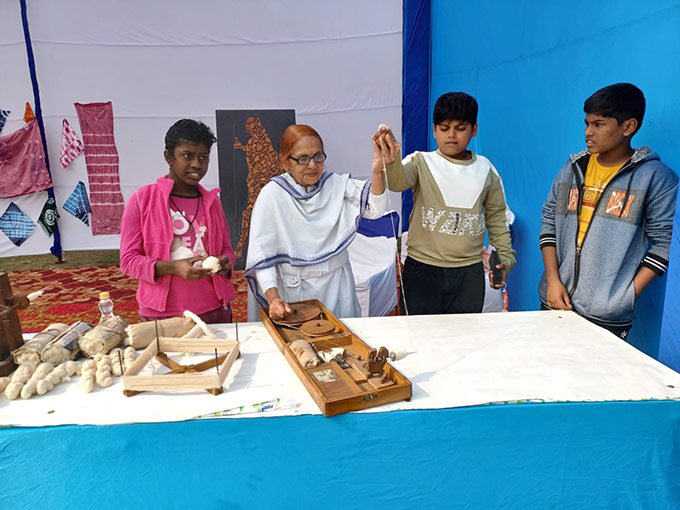
The results are not just yarn, or good-quality yarn, or high or low productivity. The results lie somewhere else. In Punjab, an indigenous or peti charkha is a part of the bridal trousseau, Laheru reminds. Women in households across Punjab, as one of my former reportages for Mint Lounge had also revealed, spin at the charkha once free of domestic chores. The paradoxical combination of remaining both productive and distracted from existential worries was intriguing. Laheru says gifting the charkha in weddings is a custom prevalent even in South Gujarat too. Women sing as they spin together.
Simple Questions; Complex Answers
To these mentors, educators and scholars, I took a seemingly simple set of questions. Will you teach me how to spin? Where should I learn to spin? Which pooni—hand-plucked organic cotton, mill-made yarn or Kala cotton, the indigenous produce of Kutch—should I use? Is it better done as a community activity or can I learn from a private tutor? How long will it take to understand basic spinning before explorations into embodiment unfold?
The responses have opened a small world where cloth, history, embodiment and purpose have sprung up clearly.
Prashant Kumar, a young model, trained to make yarn, who formerly worked with Himanshu’s 11.11/eleven eleven, and who had a long dialogue with me addressing my curiosity, spoke to me about the value of finding an unpolished peti charkha instead of an impeccably polished model. Kapur Chishti, on the other hand, responded to my “reimagination” queries to say that charkha-spinning in schools could indeed restore attention compared to assembly prayers.
Khadi expert and Phulkari scholar Sunaina Suneja, whose Phulkari exhibition wraps up in Delhi today, asked: why judge Khadi by its count? Who is to assert that 50 counts is inferior and 400-count muslin is superior?
There is, of course, a distinction I keep returning to. A woman spinning because it contributes to her livelihood is not necessarily experiencing the charkha in the same way as someone who chooses to spin as a voluntary activity. This difference in agency is part of what I want to understand.
So, what am I telling you through this?
The realisation that the charkha, a politically and ideologically loaded tool used to make a textile, can lead us to some untrodden domains of innovative ideas—that’s the focus of my research.
It must be said that I am not exploring spinning within India’s nationalist or patriotic folds. I am exploring it as a secular, cross-cultural, embodied community practice for experimentation outside the framework it has stayed in so far.
You will hear more from me on this.
Or, maybe I will hear from you.
As Induben, the Delhi-based spinner, told me over the phone, explaining why she was too busy to meet me before October 2: “Everyone is calling me for spinning. When I am back, I will phone you to come along with your charkha and poonis.”
Amen.
Banner: (L-R) Ghatit Laheru spinning yarn on a ‘Peti Charkha’, an indigenous charkha and Delhi-based spinner, Induben.