The Voice of Fashion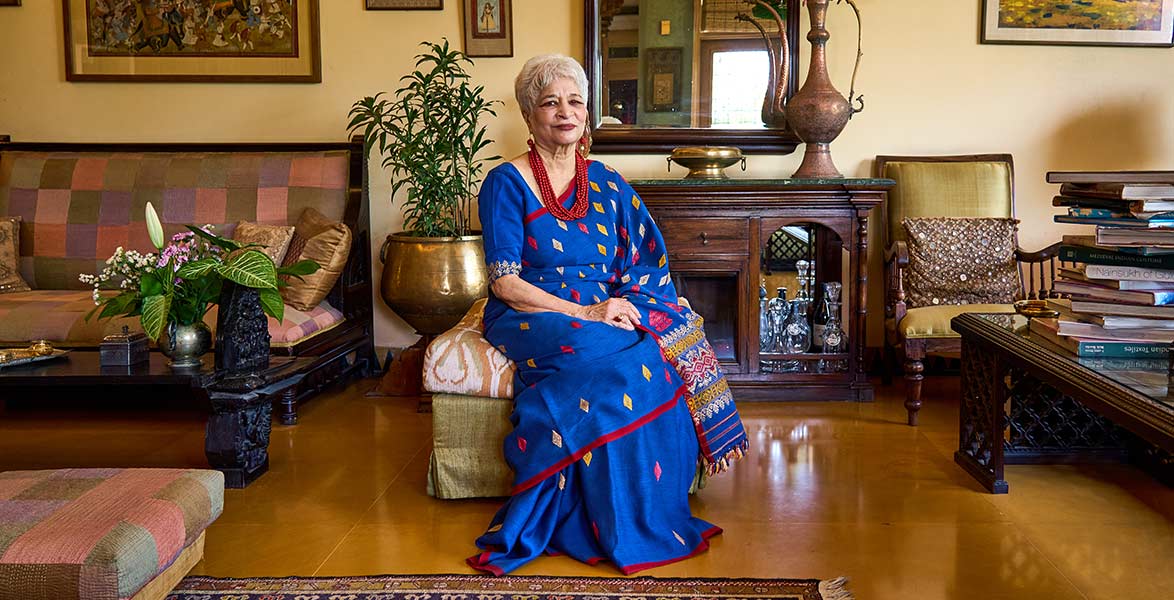
This is not merely the story of Laila Tyabji stepping back from Dastkar. It is also the story of Indian crafts, and of a certain idea of India: plural, tactile, improvisational and deeply human—now confronting new fragilities
Repetition with variation. Laila Tyabji in another red, blue, green or white sari. Another conversation about crafts in contemporary India. Another reflection after Dastkar’s recent fire tragedy. Every interview proposition around Tyabji seemed at risk of overwriting itself.
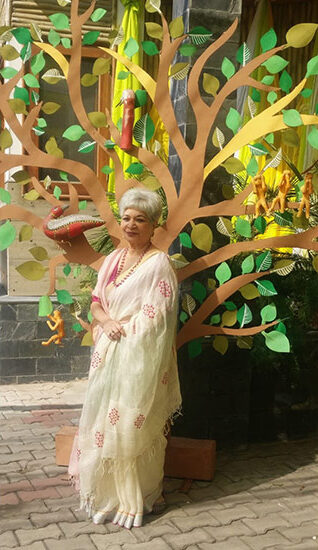
When the door to her home in Delhi’s Shantiniketan opened, the dilemma only deepened. Having interviewed her several times before, this writer found herself searching for the silences beneath Tyabji’s trademark eloquence. There she sat, posture perfect in a cerulean blue embroidered sari, on a sofa upholstered in roasted mustard ikat, surrounded by stacks of books, flowers in tall vases, Kutchi embroidered cushions and the layered fabric vocabulary of India framing her slight body.
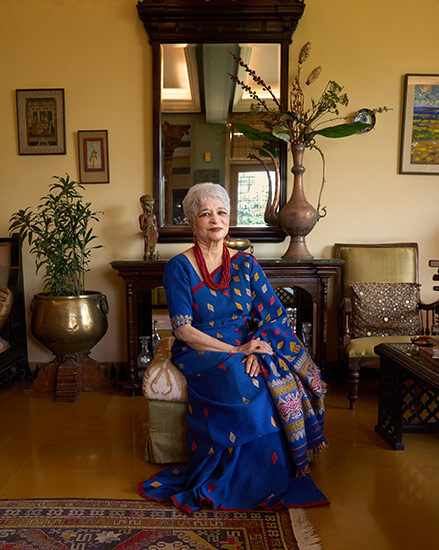
Tyabji jokingly describes herself as a “little old woman with white hair”, but she remains formidable, and not merely because of her striking presence or unwavering gaze. If anything, the progression of her hair from black to salt-and-pepper to silver has only intensified the aura around her. At 78, and having stepped back from Dastkar—the organisation she co-founded over four decades ago in 1981—she does not wear retirement easily. The coral-red necklace, brick-brown lipstick and deliberate elegance suggest not retreat, but continued alertness.
Tyabji speaks often of her parents—artist Surayya Tyabji and diplomat Badruddin Tyabji—and of the privilege that allowed her to work without anxiety about money or status. She never married (“I wanted a lover down the road, not in the same bedroom or bathroom,” she says), and later adopted her daughter, Urvashi Kumari Singh.
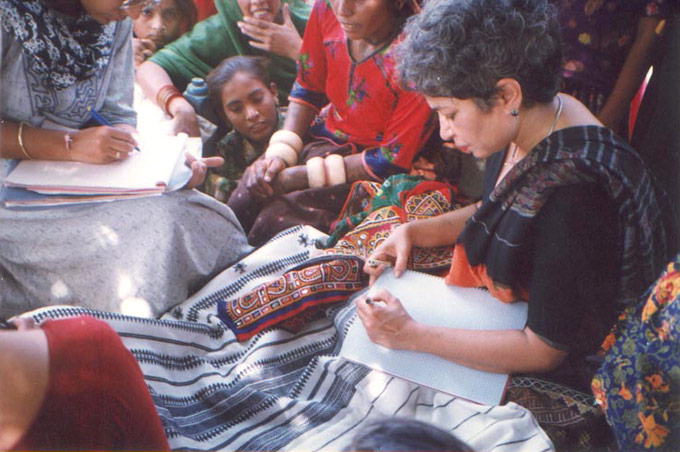
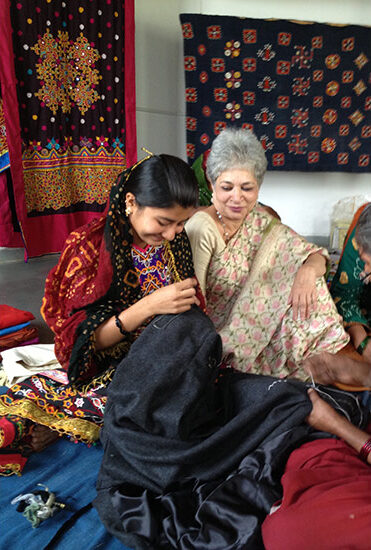
For decades, Tyabji has been less an instructor of design, more a collaborator in it—a cultural bridge-builder who learnt to speak to bureaucrats and karigars with the same articulation. She has sat cross-legged on floors with artisans in villages, embroidering cloth, correcting stitches and explaining patterns in an ongoing exchange that came to define her life’s work. It was in Kutch that she discovered what she could do and how, beginning an examined life. She also discovered skills, challenges, and emotional bandwidths. And also, the poor quality of embroidery threads, the few overused chemical dyes and several ignored punctuations to innovative, evolving design.
Design as Conversation
Those who describe their association with Tyabji often return to similar observations: her sharpness, instinctive understanding of design and ability to connect worlds that rarely meet with ease.
“I have known her since 2007, when we were setting up a jewellery division for Fabindia and later through building Jaypore. She is fiercely grounded in artisan lives, but above all, it is her sense of design that shaped how many of us value ourselves as Indians and our craft traditions,” says Shilpa Sharma, former senior leader at Fabindia and co-founder of Jaypore. Sharma describes Tyabji as singular and difficult to replace, adding that curiosity around her succession at Dastkar had begun many years ago, precisely because of how closely the organisation was identified with her.
Tyabji understood design not as instruction but comprehension. Rather than behaving like a missionary arriving in villages with quick solutions, she embodied the labour and lifestyle around craft itself. Market access can be shallow without accessing what artisans knew and “felt”.
What distinguished her work was not boutique craft romanticism, but bridge-building. It moved between artisans and markets, tradition and adaptation, rural anxieties and urban aspiration. Many place her among India’s most influential cultural workers, alongside figures such as Jaya Jaitly, founder of Dastakari Haat Samiti and textile historian Jasleen Dhamija. Others speak of her design instinct in the same breath as art and craft curator Rajeev Sethi.
That instinctive ability to move between frameworks—from an artisan mother’s lullaby to a farmer’s frustrations with systems, from rural livelihoods to urban markets—made her the “bridge”, as Priya Krishnamoorthy, founder of 200 Million Artisans, describes Tyabji.
The Human Routes
Tyabji built market access for craftspeople from Kashmir to Kutch, Ranthambore to Lucknow. But hers was never just a sterile design intervention. Instead of mythologising colour palettes, textures, threads and patterns, she took the human route.
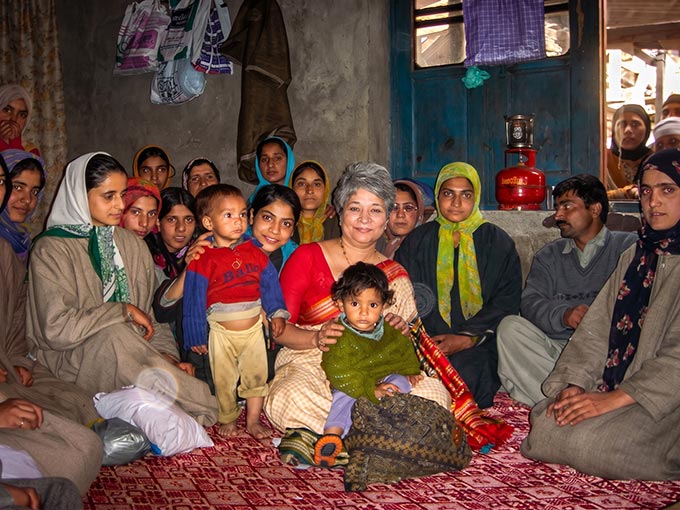
She was inside the homes of craftspeople, and even as she was squatting with them, sewing and embroidering, she also ate and cooked with them, held their babies and worried about their health, debts, emotional lives, exclusions and aspirations.
Crafts are never merely products or heritage objects preserved sentimentally, but part of how post-Independence India imagined dignity, labour and continuity.
“She would speak their language, speak to their children, bring empathy, humour and design correction with a village-level wisdom. I still don’t know how she did it,” says Shruti Jagota, board member of Commitment to Kashmir Trust (CtoK), where Tyabji continues as chairperson. Jagota, who has known Tyabji for over two decades now, says she was never intimidated by hierarchy and could move with equal ease between craftspeople, young designers and institutional stakeholders.
Tyabji’s unusually liberated life became intertwined with an equally nuanced understanding of craft. Crafts are never merely products or heritage objects preserved sentimentally, but part of how post-Independence India imagined dignity, labour and continuity. She knew this instinctively.
Across the decades after Independence, figures such as Kamaladevi Chattopadhyay, Martand Singh, Sethi, and then Jaitly and Dhamija, among many others not mentioned here, helped move Indian crafts from invisibility toward visibility. They set up institutions, training, exhibitions and market intervention. Names like Judy Frater of Somaiya Kala Vidya, Archana Shah of Bandhej, Manju Narula, Prof. Ashoke Chatterjee, who was former head of National Institute of Design, and even John Bissell of Fabindia would barely cover the list.
“For me, people like Tyabji and Gita Ram from the Crafts Council of India were foundational leadership voices,” says Krishnamoorthy. “Tyabji’s persistence, including during COVID-19 and demonetisation, helped sustain market access for craftspeople through difficult periods. I would see her Facebook posts regularly to gain understanding and motivation during COVID.”
Tyabji’s fluency across class and community gave Dastkar not only its public language, but also its body language. Guided by a tactile intelligence as instinctive as it was intellectual, she helped many craftspeople imagine themselves differently: not merely as bearers of inherited skill, but as individuals worthy of dignity and ambition.
Those who speak of her warmth and strategic brilliance also acknowledge that her charisma, privilege and exacting standards gave her authority. The karigars I spoke to repeated “Lailaben, Lailaji” with affection, gratitude and emotional attachment.
Craft, Power and Belonging
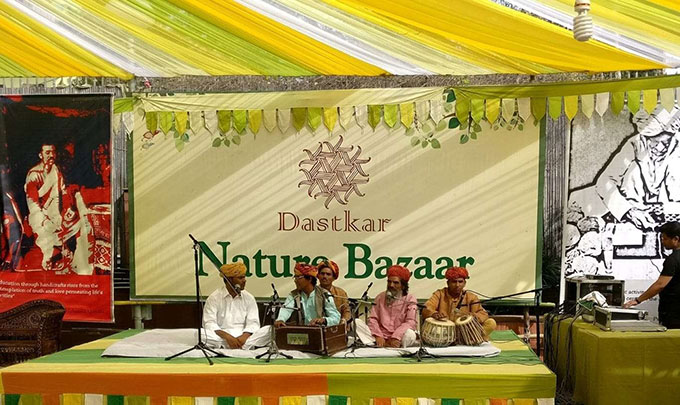
Institutional support largely favoured Tyabji and the ecosystems she helped build through most decades of her work. Dastkar was established at Nature Bazaar in Delhi’s Kisan Haat area near Chhatarpur on leased government land. The melas travelled across India while the organisation itself expanded into a widely recognised platform for craftspeople, who, in turn, discovered profitability and relevance.
In 2027, the lease for Nature Bazaar is set to expire. Finding its next home might have seemed the natural moment for Tyabji to step back. Instead, she chose to do so earlier.
The political climate in India has shifted, and that includes the ways in which crafts, craftspeople and cultural institutions are viewed and categorised. Coded suggestions, unspoken hesitations and the changing grammar of cultural legitimacy have altered the atmosphere for many public figures and organisations.
For Tyabji, the question is layered. She spent decades building bridges across caste, class, region and religion, often insisting on secular collaboration over identity. But whether her continued presence at Dastkar would have strengthened bureaucratic goodwill toward the institution or diminished it remains an unresolved question.
Funding anxieties, state negotiations, institutional fatigue and the pressures of sustaining craft ecosystems all demand persuasion, diplomacy and political balance. Sometimes, soft exclusion does not announce itself dramatically. It simply becomes the climate.
In this interview, Tyabji speaks about the personal and the professional, touches the political but retreats from loud rhetoric with characteristic nuance and grace.
Was stepping back from Dastkar a natural retirement decision?
Becoming the executive and administrative head of Dastkar was never my natural bent. I preferred the design, planning and vision side of the organisation. But over the years, crises—from demonetisation to COVID-19 to key people unexpectedly leaving Dastkar—made it difficult to step away…
At the same time, however, I also felt that my age and seniority had begun to alter Dastkar’s informal culture. Younger people found it harder to disagree openly or exchange ideas freely. So, for many reasons, I felt it was the right moment to step back. I really wanted to prove that no institute is just one individual.
You spoke many languages—humanistic, linguistic, non-verbal. Were these central to what you built?
In school I was good at English and history and art, though my art teacher at Welham Girls’ School was dreadful. Later, I went to Baroda to study fine arts thinking I would become an artist with a capital A. My father wanted me to join the Foreign Service following his footsteps. Although I loved being the daughter of a diplomat, the idea of becoming one myself did not enthuse me.
When my father was posted to Japan, I left Baroda and worked in an art studio there instead. You learn language differently that way. You learn problem-solving.
Did instinct guide you?
Instinct and the freedom my parents gave us. My father told his four children that he did not care what we did in life as long as we did it with passion and pleasure.
At boarding school, I felt I had no skills because I could not dance, swim or play games properly. But today, because I can cook and sew, write and revel in the digital world, and live happily in almost any situation, people think I am very talented. It is a beautiful contradiction.
And you rode a motorcycle once upon a time in Delhi?
Yes. A very small one. I didn’t want to depend on strange men dropping me home after evenings out!
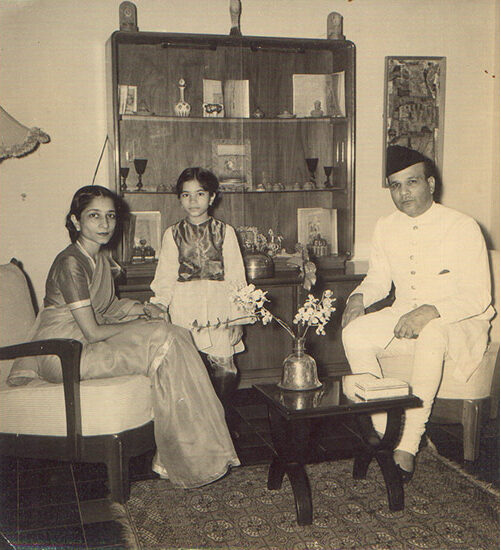
Did your parents ever urge you to get married?
No, not really. The extended Tyabji family had many free-spirited women who either never married or left marriages and built fulfilling lives for themselves. My parents recognised very early that I was probably not going to be the easiest wife for a conventional Indian man.
I always got slightly claustrophobic and used to say I wanted a lover down the lane, not in the same bedroom and bathroom. My mother would tell me, “Fine, don’t get married, but at least have a child because it is one of the most creative experiences in life.” I wish she’d seen it happen for me.
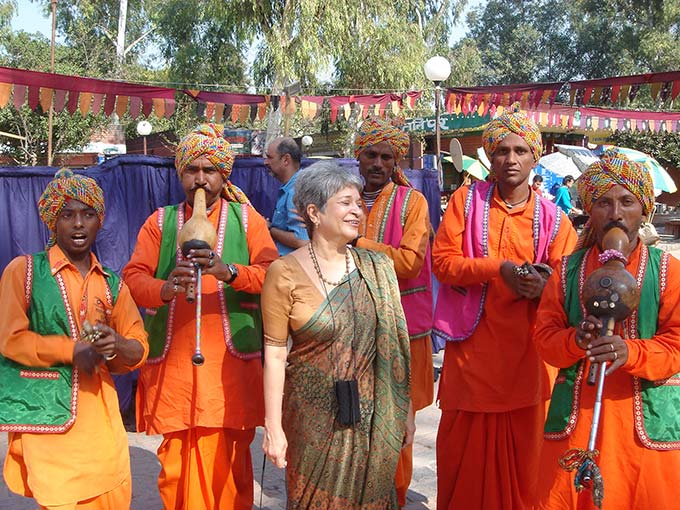
This freedom, both personal and cultural, that India offered—do you think it has changed?
I never really thought about it in those years when my father was abroad. I loved being an ambassador’s daughter—all doors were open, you could travel the world—but I always knew I wanted to come back and live in India. This is where I wanted to spend my life and I still feel like that.
My family was deeply involved in the freedom struggle, so the idea that some people today feel we do not belong here surprises me. I have never thought of myself in terms of being Muslim or Hindu by preference. But even in my very privileged life, I can say that in the last ten years, some things have shifted.
For most of my life, I felt that my family and the way we lived were an integral and useful part of this country, that we had contributed to its culture and history. Nevertheless, India has an enormous richness to offer and I would not choose to live anywhere else.
I work with everybody—tribals, Brahmins, burkha-clad women, moustachioed regurs from Rajasthan, the most chauvinistic characters imaginable—and I have honestly never found being either a woman or a Muslim to be a barrier in those relationships.
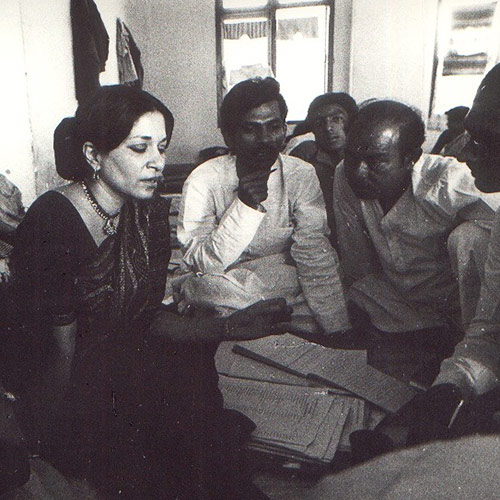
Have crafts and craftspeople really been enabled over the decades?
I have worked with craftspeople and their families for nearly 50 years, even before Dastkar. And whether it is Lucknow, Kutch or Bihar, I have seen enormous change—not just economically, but socially as well. Women embroiderers and karigars who once struggled to survive have been able to educate their children and send them into professions like medicine or engineering because craft finally began to generate income and dignity.
The irony is that many of those children no longer want to enter the field of craft themselves. Except perhaps in places like Kashmir and Kutch, where being a craftsperson still carries social respect. Younger people often see it as a difficult and uncertain life with little recognition or respect.
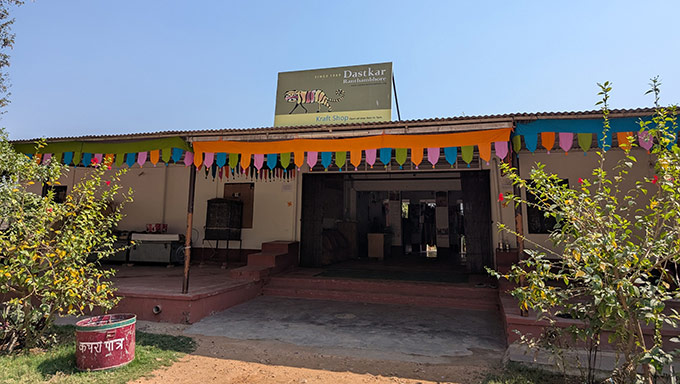
When Dastkar formally began in 1981, craftspeople could hardly believe their skills might earn a decent wage. In Ranthambore, where we started working over 35 years ago, people were desperate for livelihood. Valmik Thapar asked us to think about creating work for displaced forest communities, so I went and lived in a tiny village room there in the early 1990s. Everyone came to see what this mad behenji was about.
I would sit and stitch, make patchwork and offer tea to anyone who came in. Invite them to try their hand. Initially they could barely follow basic sequences of colour, but slowly Meenas, Mochis and Muslims—everyone—began learning together. Eventually, they could not believe that the things they made could actually earn money.
Today, from Ranthambore to Banaskantha, many of the women I have worked with for decades instinctively understand what I may be looking for in terms of colour, proportion or finish even before I say anything. That shared visual language came over years of working together.
Do you still have a dream for Dastkar?
I hope Dastkar will exist as long as craftspeople need it, and that it continues adapting spontaneously and innovatively to their realities. The moment it becomes static or unnecessary, it should close. But I suspect craftspeople will need an external helping hand for a long time.